

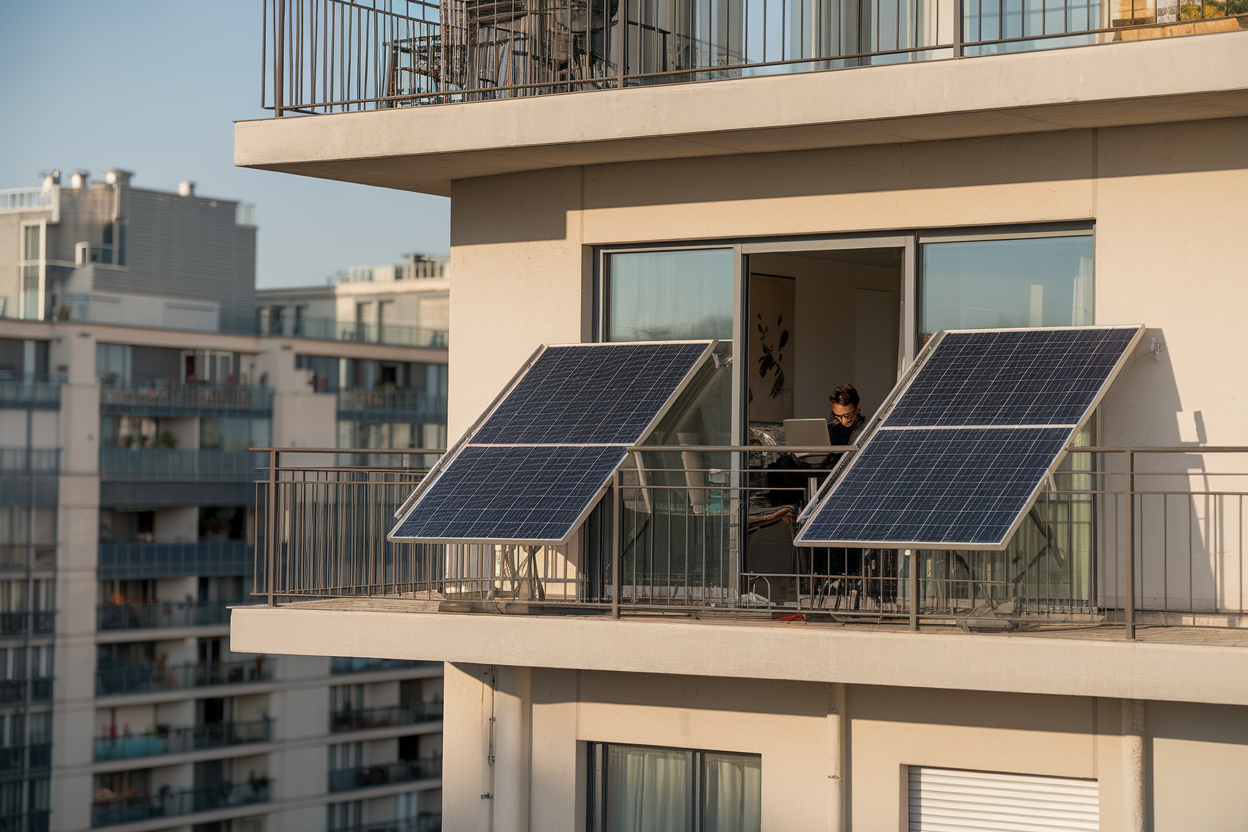
Picture this: you clamp a solar panel to your apartment balcony, plug it into a wall outlet, and—boom—you’re “making your own power.” That’s the sales pitch, anyway. Across Europe, these plug-in balcony solar kits have gone from nerdy side project to mainstream urban accessory, fueled by post-2022 energy-price whiplash and a growing itch for a little independence.
But let’s not kid ourselves. These things can shave your electric bill. They can’t turn your apartment into a mini power plant. And if you buy one on vibes instead of math—orientation, shade, your daytime electricity use—you’re basically donating money to the sun.
The hard rule is simple: without a battery, the electricity is only “worth” something if you use it right when the panel makes it. No daytime usage? Congrats, you’ve built a tiny generator that mostly helps the grid, not you.
What you’re actually buying: 1–2 panels, a microinverter, and a plug
A balcony kit is usually a stripped-down setup: one or two solar modules, a microinverter (the box that turns DC into AC your home can use), and a connection into your apartment’s electrical system—often marketed as “just plug it into an outlet.”
Modern panels commonly land around 350–450 watts-peak each. Kits marketed for balconies typically total about 300–900 watts-peak, depending on how many panels you get and what local rules allow you to feed into your home circuit.
And every little detail matters: which direction your balcony faces, whether you’re shaded by trees or neighboring buildings, how steep the panel is tilted, and even heat. City shade is brutal because it’s not steady—one building edge can slash output for hours in the morning or late afternoon.
The microinverter is the unsexy part that can make or break the whole thing. It’s responsible for safety and compliance, including the requirement that the system shuts down automatically if the grid goes out—so linemen aren’t dealing with surprise backfeed.
Then there’s the “don’t drop a panel on someone’s head” problem. A panel on a railing catches wind like a sail. If the mounting hardware is junk—or you install it like you’re hanging a flower box—you’re not just losing efficiency. You’re buying liability.
And about that plug: yes, the idea is seductive. But it assumes your wiring is in good shape, the circuit isn’t overloaded, the cables are appropriate, and your protection devices (like GFCI/RCD equivalents) are up to snuff. Older apartments, sketchy outlets, overloaded power strips—this is where “simple” turns into “stupid.”
The real limit: small power, wildly variable output, and a tyranny called “orientation”
These kits aren’t meant to cover your whole household. They’re meant to chip away at your constant baseline load: Wi‑Fi router, fridge, standby power, ventilation—stuff that hums along all day.
In good conditions, a 600 W kit might generate roughly 500–800 kWh per year. That’s a wide range because the real world is messy. A clear, south-facing balcony does far better than an east/west-facing slot canyon between buildings.
Mounting angle matters too. A panel mounted vertically on a railing won’t perform like one tilted toward the sun—especially in winter, when the sun sits lower. Urban shading can also take a disproportionate bite out of production because it clips the best parts of the daily curve.
Then comes the part the brochures whisper about: self-consumption. No battery means you need to be using power while the panel is producing it. Lots of households barely draw much electricity during the day—especially weekdays. So a chunk of what you generate may not reduce your bill the way you think.
People who work from home, run appliances midday, or deliberately schedule loads (laundry, dishwasher, water heating) get the most out of these kits. Everyone else gets a smaller win and a longer payback.
Also: forget “backup power.” In most setups, when the grid goes down, the microinverter shuts off. This isn’t a generator. If you want power during outages, you’re talking a different architecture—storage, isolation hardware, more money, more complexity.
What it costs in dollars—and why the savings are usually modest
In France, these kits commonly run about €300–€600 for entry-level gear and €700–€1,200 for more complete setups with two panels, a reputable microinverter, and sturdier mounts. In U.S. money, that’s roughly $330–$660 on the low end and $770–$1,320 on the higher end, depending on exchange rates and what’s included.
Sometimes you’ll also need electrical work—because your panel can be “plug-and-play” and your apartment can still be “plug-and-pray.”
The savings math is brutally basic: (kWh you produce and actually use) × (your electricity rate).
The French example uses €0.25/kWh (about $0.27/kWh). If you self-consume 400 kWh/year, that’s about €100/year (roughly $110/year) saved. If you only self-consume 250 kWh, you’re down around €62.50 (about $70).
Best-case payback can land around 5–10 years. But if your balcony is shaded or you’re never home during the day, it can stretch past a decade.
Panels often carry 20–25 year performance warranties (with gradual degradation). Microinverters can have shorter lifespans depending on heat and build quality—something buyers love to ignore until the day it dies.
And yes, you can add a battery. But for small systems, batteries often torch the economics: higher upfront cost, efficiency losses, aging, safety considerations. Storage can make sense for certain usage patterns, but it’s not an automatic “upgrade.” It’s a whole new spreadsheet.
Apartment reality: HOA/condo fights, safety, and insurance headaches
This is where the dream runs into the building manager.
Mounting a panel on a balcony railing changes the exterior appearance of the building. In many condo/co-op setups (and plenty of European “copropriété” equivalents), that’s regulated. You may need approval from the association or at least formal notice to the property manager. And people do get told no—because aesthetics, fear of lawsuits, or because nobody wants to set a precedent for the entire building turning into a solar porcupine.
Mechanical safety is the next landmine. Wind loads at higher floors can be nasty. If the panel comes loose, you own that problem—legally and financially. Some balconies simply aren’t suitable, especially in windy areas or at height.
Electrical safety isn’t optional either. Plugging generation into a home circuit demands a compliant setup and proper protection. If your place has old wiring, missing grounding, or overloaded circuits, you’re asking for trouble. And insurers tend to get very curious after a fire: Was the equipment certified? Installed correctly? Any DIY “creative solutions”?
One more thing nobody puts on the product page: your neighbors have eyes. Some will cheer. Others will complain. In dense buildings, social friction can be the hidden tax that kills adoption.
And portability? Sure, you can take it with you when you move. But your next place might face the wrong direction, have no usable balcony, or have stricter rules. Then your “portable” kit becomes closet clutter.
Why city dwellers keep buying them anyway
Because most apartment residents don’t have a roof to work with. A balcony kit is a micro-investment—cheaper and simpler than a full rooftop system—and it scratches the itch to produce at least some of your own power.
High electricity prices have also made small savings feel emotionally satisfying. Some kits come with apps that show real-time production, which can nudge people into running appliances when the sun’s doing its thing. That feedback loop is real—and for some households, it’s the whole point.
The market is also splitting into two lanes: bargain kits with murky components and premium kits selling traceability, longer warranties, and name-brand microinverters. If you’re shopping, compare the stuff that actually matters: watts-peak, warranty terms, mounting hardware strength, and whether the system is designed for shade and partial obstruction.
But the biggest risk is impulse buying—no check on sun exposure, no building approval, no look at the electrical panel. The future of balcony solar won’t be decided by marketing. It’ll be decided balcony by balcony, by whether people install them safely and legally—and whether the savings match the hype.
Quick answers (the stuff people actually ask)
Will a balcony solar panel power my apartment during a blackout?
Usually no. Most microinverters shut down when the grid goes out unless you’ve built a dedicated, isolated backup system with storage.
How much can a 600 W kit save in a year?
A rough ballpark from the French figures: about $70–$110/year, depending on how much you self-consume (around 250–400 kWh) and your electricity rate.
Do I need condo/HOA approval?
Often yes, because it changes the exterior appearance and raises safety/liability issues. Check your building rules before you buy.