

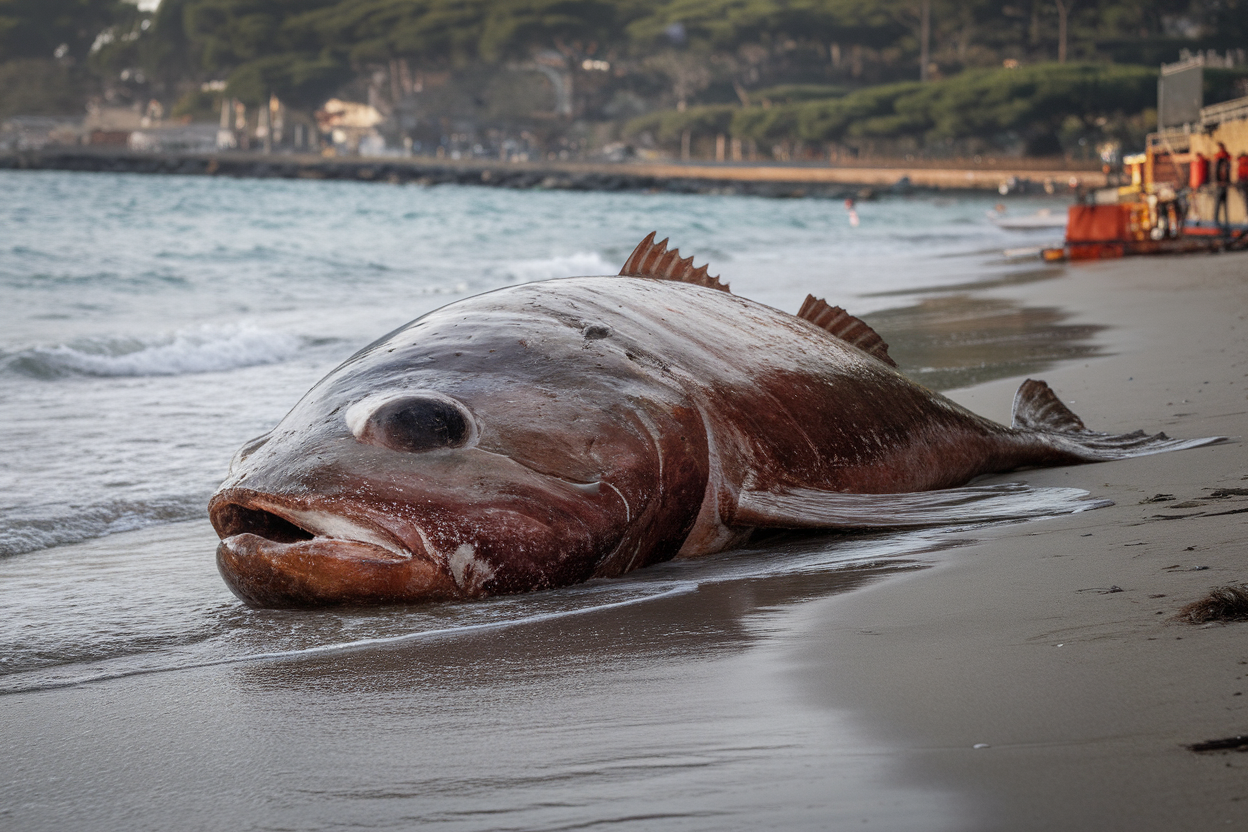
A massive ocean sunfish—one of those oddball, dinner-plate-shaped giants of the open sea—turned up dead on a beach in Marina di Ravenna, on Italy’s Adriatic coast. One minute it’s a normal day by the water. Next minute, you’ve got a deep-ocean creature sprawled on the sand like a biological crime scene.
The carcass was taken in by CESTHA, a local habitat-protection research group, with help from the port authority. The plan: get it into a lab, put veterinarians on it, and figure out what killed it.
A March 10 beach surprise in a place known for strolls, not sea monsters
Italian media flagged the find on March 10. Marina di Ravenna isn’t exactly famous for close encounters with big pelagic fish—animals that spend their lives offshore, roaming huge distances where humans mostly don’t go.
Early visual checks reportedly didn’t show the obvious stuff: no clean propeller gashes, no clear net wounds. But that’s the kind of “good news” that doesn’t actually tell you much. Plenty of lethal problems don’t leave a neat signature on the skin—internal injuries, infections, stress, or a slow decline that ends with an animal too weak to stay out in deeper water.
CESTHA and the port authority moved fast to secure the body for testing
CESTHA, backed by the port authority, recovered the animal and transferred it for veterinary exams and lab analysis. That’s not just bureaucratic box-checking. With a species like this, a full adult specimen you can actually examine up close is rare.
And yes, it’s grim. But strandings can be a snapshot of what’s happening offshore—health, food availability, human impacts, disease—if the science is done carefully and nobody jumps to conclusions because the photos look dramatic.
Was this the same sunfish rescuers tried to push back offshore days earlier?
There’s another wrinkle: CESTHA members reportedly tried to help a struggling sunfish in the same area a few days before, attempting to guide it toward deeper water.
Here’s the catch—nobody has confirmed it’s the same animal. And that matters. Pelagic fish can drift or swim toward shore for a bunch of reasons: illness, exhaustion, disorientation, or injuries you can’t see from the outside. Without a solid ID, linking the earlier “rescue” to the final stranding is guesswork. The lab work is what separates a tidy story from an accurate one.
Meet the sunfish: a living disk that “flies” underwater
If you’ve never seen an ocean sunfish (genus Mola), picture a fish designed by committee and approved by nobody. It’s laterally flattened—almost a disk—with a back end that looks chopped off. Instead of a normal tail fin, it has a fan-like structure called a clavus.
Its main propulsion comes from long dorsal and anal fins. The Natural History Museum of Venice likens the motion to bird wings, which is a surprisingly good mental image: it doesn’t so much “swim” as it sort of flaps and glides.
The museum also notes the skin lacks scales and feels rough thanks to microscopic structures, and that parts of its skeleton are cartilaginous. Another detail that trips people up: sunfish often hang near the surface and can look almost motionless. To an untrained eye, that can look like distress—even when it isn’t. In a stranding situation, that nuance matters.
Even the species ID isn’t a throwaway detail
This isn’t only about how one animal died. It’s also about what, exactly, it was. A 2026 article in Frontiers notes the genus Mola is generally treated as having three valid species. That’s a reminder that careful identification during a stranding—especially with a large adult—can feed into bigger scientific questions about classification and distribution.
For researchers, a recovered adult can help document anatomy and biology for animals that live far from shore, outside the daily view of scientists and the public alike.
Yes, they eat jellyfish—no, that’s not the whole story
Sunfish have a reputation as gelatin-eaters: jellyfish, salps, ctenophores—creatures that are mostly water and don’t exactly scream “high-calorie meal.” In the Mediterranean, a stable-isotope study reported that sunfish primarily relied on gelatinous zooplankton, backing up the idea that these squishy prey really do matter, even if they don’t leave obvious chunks in a stomach.
But field observations show they also eat squid, small fish, and crustaceans. That broader menu matters because shifts in offshore food—what’s available, where it is, and how hard it is to find—can affect body condition and movement. A weakened animal is the one that ends up close to shore, where it doesn’t belong.
A stranding is a clue—not a verdict
When a big pelagic animal washes up, people rush to turn it into a symbol: pollution, climate, fishing, shipping, take your pick. Sometimes they’re right. Sometimes they’re just early.
The scientific value here is the unglamorous part: internal lesions, signs of infection, abnormalities, and evidence of human interaction that isn’t obvious at first glance. Marina di Ravenna’s dead sunfish is a reminder of how little we routinely see of offshore life—and how much a single carcass, handled properly, can still teach us.