

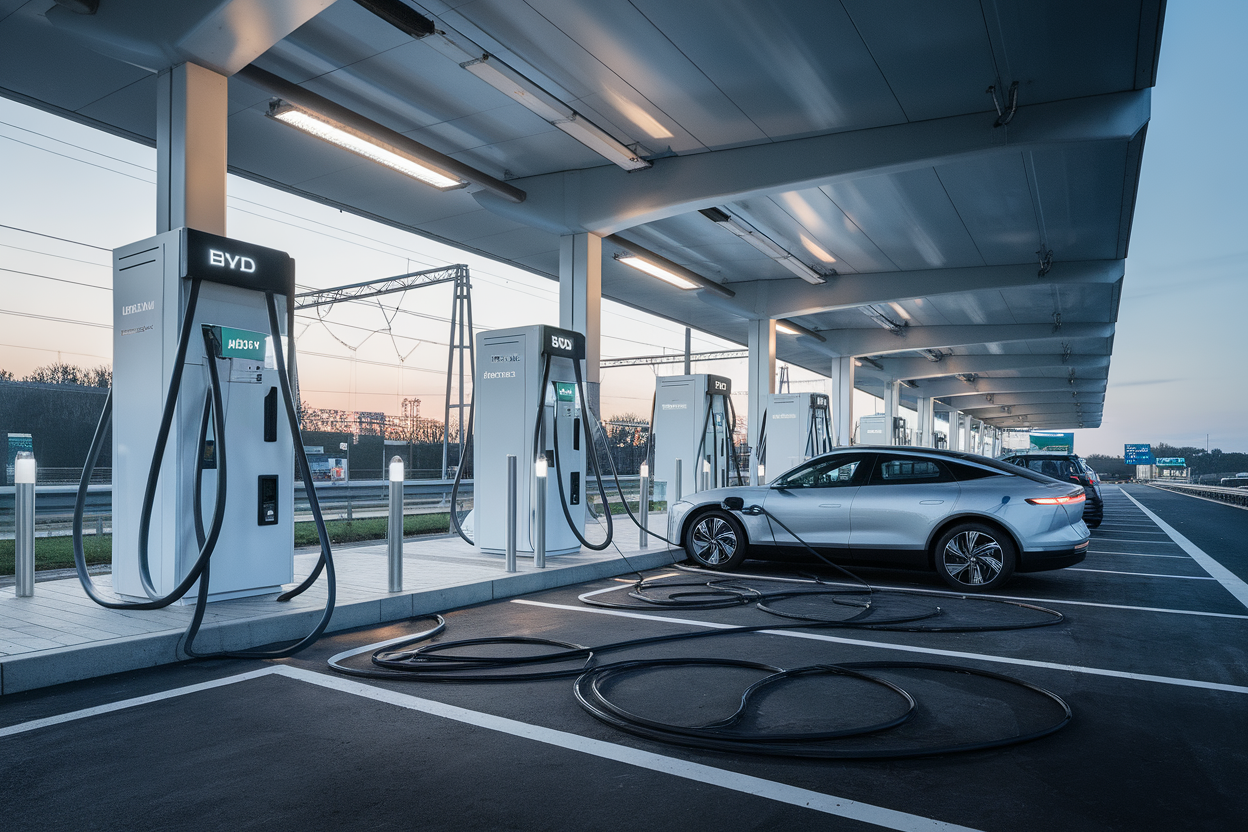
BYD says it wants to drop 2,000 “flash” charging stations across Europe, each supposedly capable of blasting out 1,500 kW per charger. That’s a jaw-dropper on paper—and a direct shot at one of the two big reasons people still hesitate on EVs: waiting around for the battery to fill (the other is range).
But here’s the part the press-release crowd always mumbles: a charger’s advertised power and what your car actually takes are two different things. And getting 1,500 kW to show up in the real world depends on the car, the cable, the site’s grid connection, and whether the station is sharing power with other vehicles. Translation: not everyone gets the headline speed, and not everywhere.
BYD also hasn’t laid out the kind of nuts-and-bolts plan you’d expect for something this ambitious—no clear timeline, no country-by-country rollout, no named partners, no map of where these things will actually go. That gap between big technical claims and operational details is where these projects usually live or die.
2,000 stations, 1,500 kW: what BYD is actually promising
The concrete part of BYD’s announcement is basically two numbers: 2,000 stations and 1,500 kW charging power. In industry terms, that’s “megawatt charging”—way beyond the typical European fast chargers that sit around 150 kW, and even above many of the newer high-power sites topping out around 350 kW.
At 1,500 kW, you’re not installing a glorified parking-lot kiosk. You’re building heavy infrastructure: serious grid upgrades, transformers, and cooling systems for cables and connectors that would otherwise cook themselves. Operators already complain about the construction and utility headaches of 150–350 kW sites. Multiply that by four or ten and you’re talking about projects that can require local electrical reinforcement—or on-site battery storage to smooth out demand spikes.
BYD has a clear motive here. If you sell cars that can charge faster, you want a network that makes that speed feel real. It’s the same playbook Tesla used early on: don’t just sell the car, sell the refueling experience. The difference is Europe isn’t one unified market—it’s a patchwork of charging operators, pricing schemes, regulations, and standards.
Disney’s Live-Action “Moana” Trailer Puts The Rock Front and Center as Maui
And 2,000 stations isn’t a “let’s test this in one city” number. It signals a real attempt at coverage. But without knowing whether these are planned for highways, urban hubs, shopping centers, dealerships, or logistics depots, the promise stays fuzzy.
That 1,500 kW number depends on your car, the cable, and the grid
A charger can brag about 1,500 kW all day. Your car still has to accept it. To get anywhere near that level, you need the whole chain to cooperate: a vehicle designed for extreme charging rates, a battery that can take the current without degrading or overheating, strong thermal management, and hardware (connectors/cables) built for it.
Most EVs on European roads today aren’t built for that. Even models known for fast charging often peak around 150–250 kW—and only briefly—before tapering down to protect the battery. That’s why charging curves matter more than marketing numbers. BYD’s announcement immediately invites the obvious follow-up: which models, exactly, and when, will actually use a meaningful chunk of 1,500 kW?
Drohnenangriff in Dubai: Emirates-A380 beschädigt – offenbar mindestens zwei Ziviljets getroffen
Then there’s the site reality. A station can claim 1,500 kW “per stall,” but if multiple cars plug in, the hub may split available power depending on how it’s engineered and what the utility connection can deliver at that moment. Drivers don’t experience “nominal power.” They experience whether the charger delivers when they show up.
Finally, the cable and connector become the story. At these power levels, heat is the enemy. Industrial solutions often rely on liquid-cooled cables and specialized connectors. Europe largely uses the CCS standard for fast charging; pushing into megawatt territory can mean hardware and software changes. If compatibility is limited, the network risks serving a narrower slice of vehicles—possibly BYD’s own customers first.
Europe rollout: the grid and the permit office will decide what’s real
Installing 2,000 ultra-high-power stations isn’t like ordering a bunch of chargers and calling it a day. The bottleneck is usually the grid connection. Europe’s distribution and transmission operators require studies, upgrades, and timelines that vary wildly by country and location. In areas where the grid is already strained, getting multiple megawatts of capacity can take a long time—meaning the hardware might be ready long before the site can actually open.
Permitting is its own beast: construction approvals, safety compliance, accessibility rules, traffic flow planning, sometimes local consultation. A high-power charging hub starts to look like a small infrastructure project, not a retail add-on.
And the economics aren’t cute. Ultra-fast sites cost more to build and more to operate—especially when utilities charge hefty fees for high-capacity connections. To make the math work, you need steady traffic, which means premium locations that everyone else wants too.
There’s also the energy problem: even if a megawatt charge session is short, it creates sharp demand spikes. Operators can blunt that with on-site battery storage, but that’s more capital and more complexity. Meanwhile, European countries are trying to electrify heating, industry, and transportation at the same time. The grid isn’t infinite.
Consumers, for their part, don’t grade chargers on spec sheets. They care about whether the station works, whether it’s available, whether payment is painless, and what the price per kWh looks like. A “flash” network that’s flaky or frequently throttled will get roasted, no matter how impressive the brochure sounds.
A promise that won’t reach everyone—by design and by reality
Start with compatibility. If only a handful of vehicles can charge anywhere near these rates, then for most drivers these stations will behave like regular fast chargers—no miracle, no “gas-station quick.” In that scenario, the announcement still helps BYD: it plants a flag as a tech leader even if mass benefit comes later.
Next is access. BYD could build and operate the network itself, partner with existing players, or bake in perks for its own customers—discounts, priority access, tighter integration with in-car navigation. That kind of walled-garden advantage already exists in charging, and it can tilt competition fast. It also invites backlash if prime locations end up feeling semi-private.
Then there’s geography. Even with 2,000 stations, Europe is big and uneven. The first sites will land where EV traffic is high and grid connections are feasible: major highway corridors, EV-heavy countries, big metro areas. Rural regions and countries with tougher grid constraints will wait longer. The result: real improvement for some trips, and the same old hassle for others.
BYD’s bigger play is clear: compete in Europe on the day-to-day ownership experience, not just sticker price. But the only scoreboard that matters is openings—actual addresses, actual dates, and charging performance drivers can verify in the wild.