

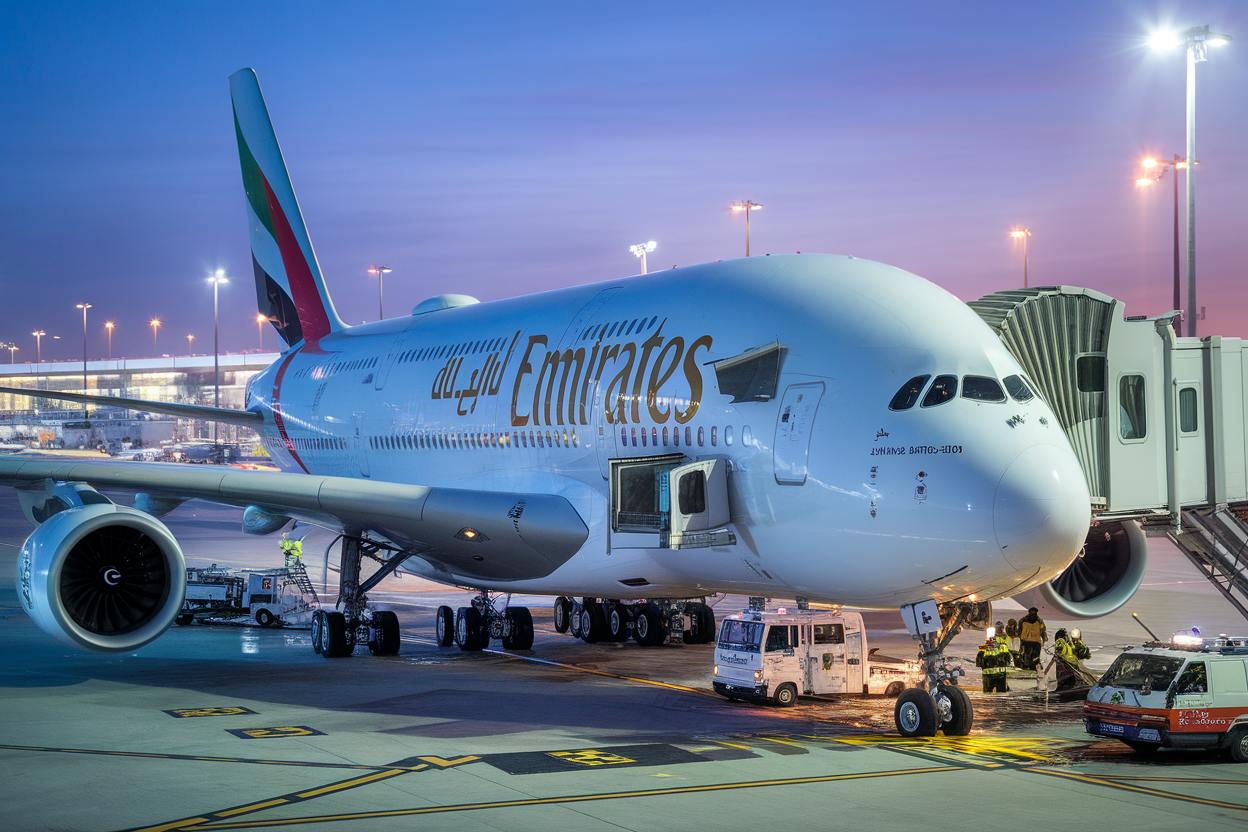
Dubai sells itself as the place where the world connects—gleaming terminals, endless duty-free, and a flight schedule packed tighter than a Manhattan subway at rush hour. Now it’s also a reminder that the Gulf’s biggest aviation hub sits inside a very real shooting gallery.
Security sources cited by multiple media outlets say an Emirates Airbus A380 was damaged at Dubai International Airport during a drone attack attributed to Iran. And it wasn’t a one-off: the same reporting says at least two civilian aircraft were hit.
Officials haven’t released a full damage report, and not every airline involved has spoken publicly. But the headline writes itself: commercial aviation—long treated as the thing you don’t touch if you want to avoid global blowback—just got dragged closer to the front line.
Why Dubai matters: hit the hub, shake the system
Dubai International isn’t some regional airstrip. It’s one of the busiest airports on Earth, a critical junction linking Europe, Asia, and Africa. When something goes sideways there, the ripple doesn’t stop at the city limits—it runs through airline networks worldwide.
And if you’re trying to cause maximum disruption with minimum effort, an airport like Dubai is a fat target. You don’t need to crater a runway to create chaos. A drone strike near a parking stand, a taxiway, or a cargo area can force closures, trigger inspections, and jam up departures until the delays stack into a full-blown schedule collapse.
The point isn’t just physical damage. It’s doubt. Doubt drives cost—more security, higher insurance, more contingency planning, more delays passengers will remember the next time they’re picking flights.
Drones vs. airports: the ugly gap between “security” and “air defense”
Airports are built to stop the classic threats: someone sneaking in through a fence, a suspicious bag, an insider with bad intentions. Drones are different. They come in low, fast, and often hard to separate from the background clutter of a dense city.
Dubai’s geography doesn’t help. The airport sits in a packed urban environment, with approach and departure paths over areas you can’t exactly “lock down.” A drone doesn’t have to reach an active runway to cause havoc; it can target aircraft on the ground or infrastructure that keeps the whole machine moving.
And the response is a minefield. Jamming signals can interfere with legitimate systems if it’s not tightly controlled. Shooting drones down can create debris—exactly what you don’t want around jet engines and fuel trucks. That’s one reason official statements tend to be cautious: admitting an attack also invites questions about what defenses worked, what didn’t, and what gaps remain.
An A380 isn’t a fender-bender: one damaged jet can wreck a week of planning
For Emirates, the A380 isn’t just another plane—it’s the brand’s flying billboard and a core piece of its capacity strategy. Take one out of rotation and you don’t just inconvenience a few travelers; you scramble hundreds at a time.
Even “minor” damage on a commercial airliner triggers a heavy, methodical process: the aircraft gets grounded, inspected, documented, and cleared only when engineers can prove it’s airworthy. With an A380—an aircraft with complex systems and massive structure—those checks can be especially time-consuming.
Replacing it on short notice isn’t like swapping a bus. You need a comparable aircraft, crews qualified on that type, gate space that can handle a superjumbo, and workable takeoff/landing slots. Airlines plan this stuff weeks out. A surprise grounding punches a hole straight through that plan.
“At least two civilian aircraft”: that detail changes the whole story
If it’s truly two civilian planes hit, that suggests either a wider impact area or a more complicated attack sequence. Either way, it’s not a random scrape.
Aircraft parked on the ground are vulnerable: they’re clustered together, surrounded by fuel and critical equipment, and often positioned near infrastructure that keeps the airport running. Multiple damaged planes also means multiple inspections, more operational slowdowns, and more pressure on the airport authority to prove the situation is contained.
And here’s the part passengers never see: after an incident like this, airports don’t just check the planes. They sweep taxiways and runways for debris because a small piece of metal sucked into an engine can turn a bad day into a catastrophe.
The money angle: insurers, war-risk clauses, and the price you’ll pay later
When an attack is attributed to Iran, it doesn’t stay a local security matter. It becomes a boardroom problem—fast.
Airlines, aircraft lessors, and insurers live by risk maps and contract language. A drone strike tied to a state actor can trigger thorny questions about war-risk coverage, deductibles, and what counts as an “act of war” versus terrorism versus sabotage. Those aren’t academic debates. They determine who eats the cost of repairs, cancellations, and disruption.
And when insurers get nervous, premiums rise. Airlines operate on thin margins. Higher insurance and security costs don’t get absorbed out of kindness—they show up in fares, fees, and less flexibility when things go wrong.
Dubai can reopen gates quickly. Restoring confidence takes longer, especially when the threat comes from the air and the target is a civilian hub everyone assumed was insulated from direct hits.