

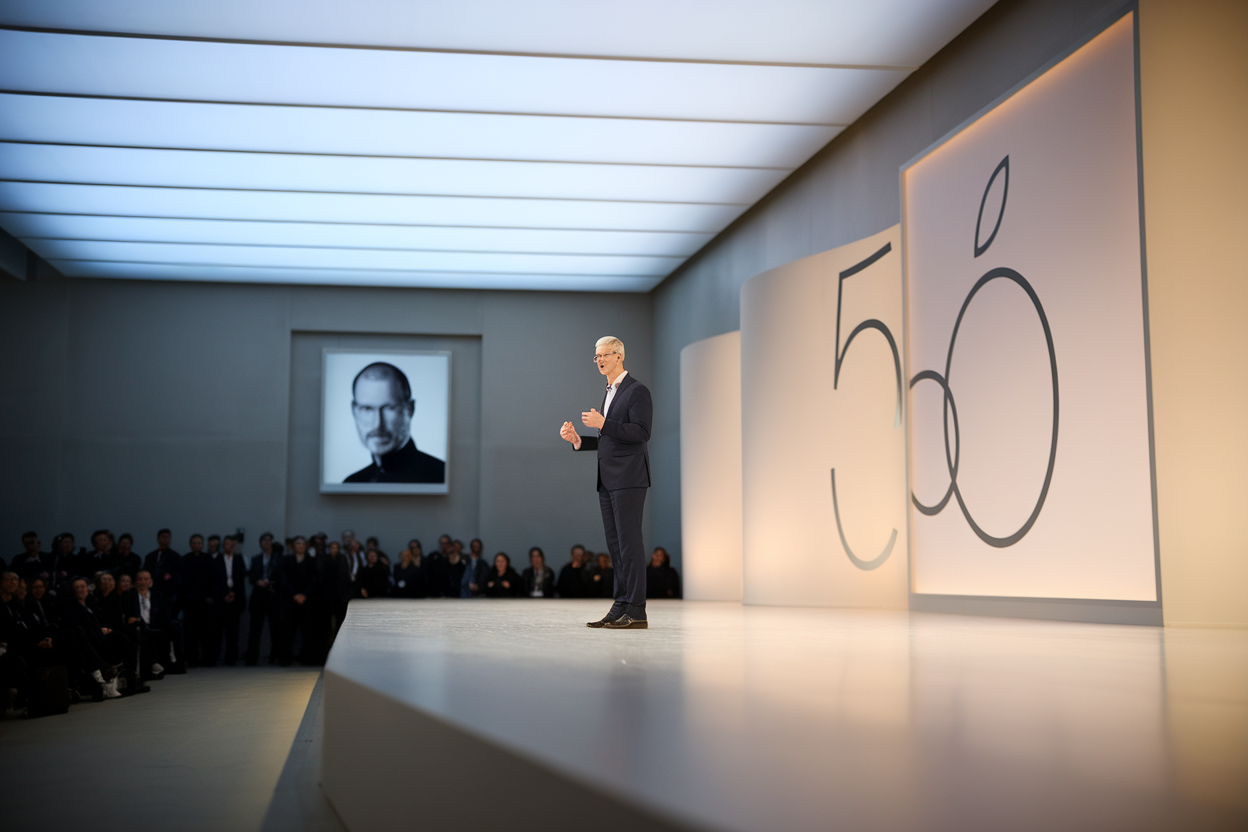
Apple just hit the big 5-0, and you can practically hear Wall Street clearing its throat: “So… when’s Tim Cook leaving?”
Cook’s answer wasn’t a retirement tease or a coy non-denial. He tried something smarter—he dragged Steve Jobs back into the conversation. Not as a ghost story, but as a blunt reminder of who still sets the company’s internal compass. Cook invoked what he described as Jobs’ final piece of advice to him, then swatted away the idea that he’s about to walk out the door.
That pairing—Jobs’ last words plus a Cook-stays-put message—isn’t accidental. It’s Apple doing what Apple always does: controlling the script before someone else writes it for them.
Apple at 50: not a scrappy rebel, a global machine that hates surprises
At 50 years old, Apple isn’t the weird little upstart anymore. It’s a global institution—watched by investors, regulators, rivals, and a customer base that treats product rumors like sports betting.
And when you’re that big, “succession” isn’t gossip. It’s a recurring line item. Apple’s leadership history is basically a two-act play: Jobs, then Cook—two wildly different personalities, same obsession with control and execution.
So when Cook speaks publicly about leadership, it’s never just chatter. It’s a signal flare.
Steve Jobs’ “last advice”: Apple’s favorite kind of proof—myth with a purpose
Apple has always curated the memory of Steve Jobs like it’s part of the product line. Not only through tributes and archives, but by framing today’s decisions as extensions of the original vision.
So Cook bringing up a “last” piece of advice from Jobs—right at the 50-year mark—works like a stamp of legitimacy. It tells employees, partners, and investors: the culture didn’t die in 2011; it got institutionalized.
It also pushes back on an old critique of the Cook era: that Apple became a manager’s company, not a visionary’s company. Mentioning Jobs is a way of saying, “You think we forgot the religion? We didn’t.” Cook’s style is operational, yes. But the company wants you to believe the underlying doctrine—simplicity, quality, tight hardware-software integration—never changed.
And anniversaries are perfect cover for this kind of messaging. It sounds reflective instead of defensive.
Cook denies he’s heading for the exits—and that matters more than people admit
The other half of Cook’s message was more direct: he pushed back on rumors that he’s about to step down.
Normally Apple treats speculation like it treats leaks: no comment, move along. So the fact Cook chose to address it suggests the chatter was starting to stick.
For Apple, governance is financial infrastructure. Markets don’t price “vibes”—they price risk. And leadership uncertainty is risk, especially for a company whose value depends on relentless execution: a massive supply chain, predictable product cycles, and a services business built on keeping hundreds of millions of people locked into the ecosystem.
Inside the company, succession rumors can also turn into a slow-motion food fight. People stall decisions. Others start jockeying. Cook’s denial is a way to slam the door on an internal pre-campaign before it becomes a distraction.
Succession has been Apple’s permanent subplot since 2011
Ever since Jobs died in 2011, Apple has lived with the same nagging question: can the brand keep its identity without the founder’s gravitational pull?
Cook’s answer over the years has been to build an institution—process, hierarchy, committees, scale. Jobs was theater and confrontation. Cook is continuity and logistics. And at Apple’s current size, logistics isn’t boring—it’s existential.
The company’s growth now leans less on a single “big reveal” moment and more on ecosystem gravity: services, retention, and a gigantic installed base. In that world, steady leadership reads as performance insurance, even if it doesn’t guarantee the next hit product.
When the transition eventually comes, Apple will almost certainly try to stage it the way it staged the post-Jobs era: internal promotion, continuity talk, no messy public contest. Cook’s comments fit that playbook—cool the rumors without inviting a public audition.
Why Apple chose to talk now: rare words, carefully spent
Apple doesn’t talk much, and it definitely doesn’t talk casually about leadership. When it does, it’s because the company thinks the outside narrative is drifting in a direction it doesn’t like.
The 50th anniversary gives Cook a clean stage: he can address governance without looking like he’s responding to pressure. And by tying his own stability to Jobs’ legacy, he wraps a potentially jittery topic (succession) in the warm blanket of Apple mythology.
There’s also a broader backdrop: Big Tech leadership has been churning, sometimes abruptly, and regulators are watching these companies like hawks. A firm that looks like it’s mid-transition can look vulnerable. Apple would rather project control—even if plenty of controversies remain.
The underlying bet is clear: Apple wants stability to feel like an asset, not stagnation. Cook’s message wasn’t a product pitch. It was reassurance—delivered in the only language Apple truly believes in: the story of Apple.