

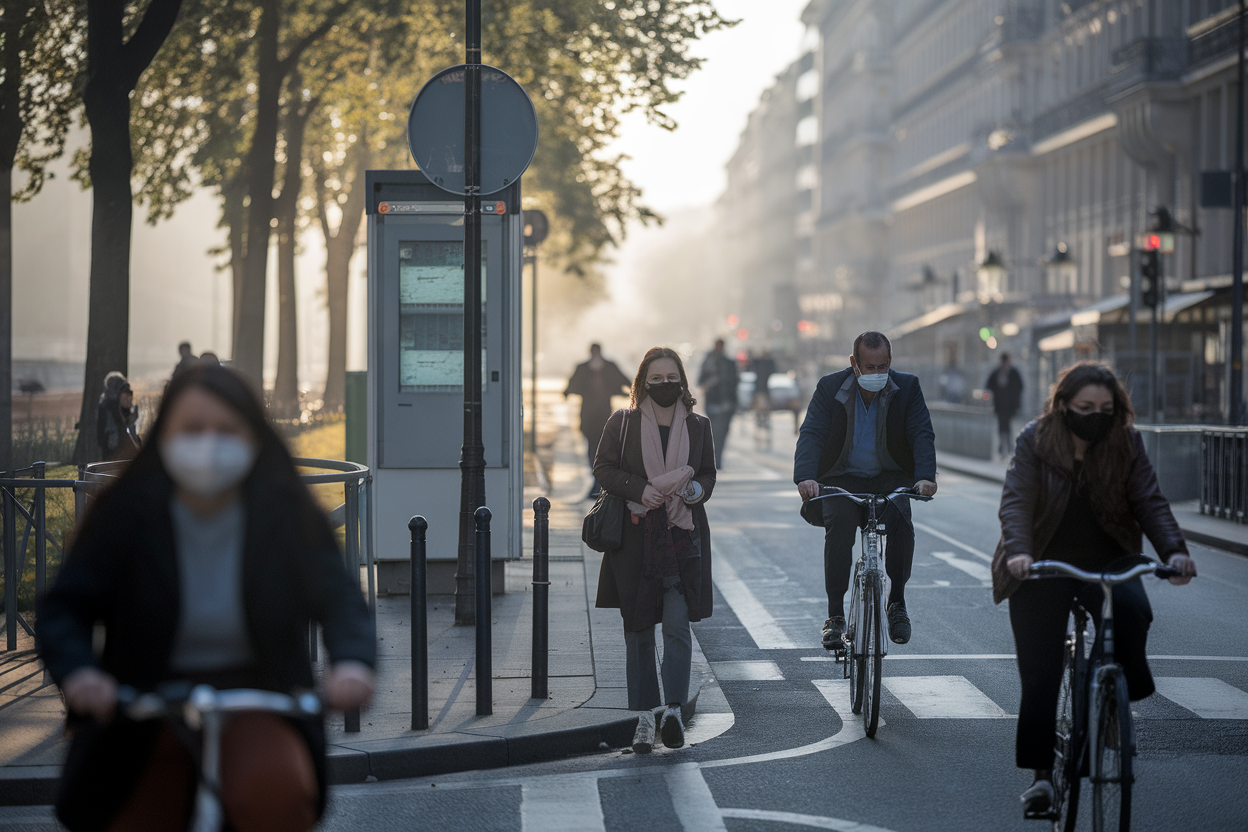
You know that comforting little phrase regulators love—“within acceptable limits”? Yeah. About that.
Researchers at the University of Mississippi are pushing a blunt message back into the spotlight: air pollution can still mess with your health even when it’s below federal limits. Those limits are policy guardrails, not a magic force field.
And the French air-quality watchdog Airparif—think of it as the Paris-region equivalent of a local air district—has been saying the quiet part out loud for years: breathing polluted air raises the risk of illness and death. The real question isn’t “Did we break the rule today?” It’s what steady, everyday exposure does to people over months and years.
Mississippi’s point: “Legal” doesn’t mean “safe”
The University of Mississippi study boils down to one inconvenient sentence: air pollution can potentially harm health even when it stays under federal thresholds.
That matters because Americans routinely confuse a regulatory limit with a biological limit. They’re not the same thing. A regulatory limit is a compromise—part science, part economics, part politics, part “what can we enforce without the whole system melting down.” It’s designed to reduce risk, not erase it.
Your lungs and blood vessels don’t care what Congress, the EPA, or a state agency agreed was “reasonable.” The body reacts on a continuum: inflammation, oxidative stress, worsening respiratory and cardiovascular disease. So if harm can happen below the line, “acceptable” starts to sound like a word that works better for spreadsheets than for kids with asthma.
A line that gets repeated in public-health circles (and echoed in the sources behind this French piece) captures it cleanly: there’s no such thing as a risk-free level of air pollution. That doesn’t mean every breath is a medical emergency. It means risk doesn’t vanish because a government document says you’re in compliance.
Paris-region data: particles, ozone, nitrogen dioxide—pick your poison
Airparif, which monitors air quality across the Île-de-France region (greater Paris), lays out the health impacts in plain terms: air pollution increases morbidity and mortality.
They tie exposure to higher risk of developing—or worsening—diseases including lung cancer, COPD (chronic obstructive pulmonary disease), asthma, and even laryngitis.
And they don’t let “short-term exposure” off the hook either. Airparif points to epidemiological research showing that day-to-day swings in pollution—especially fine particles, ground-level ozone, nitrogen dioxide, and sulfur dioxide—can hit health quickly, affecting hospitalizations and death rates.
Here’s the nasty paradox: a day can look “fine” on an index and still add to real, measurable harm—especially when it’s one of many similar days, or when it lands on people who are already vulnerable.
You don’t “use” air once in a while like a cleaning product. You inhale it constantly. That’s the whole problem.
It’s not just your lungs—pollution shows up in the heart (and maybe the brain)
Most people hear “air pollution” and picture coughing, burning eyes, maybe an asthma inhaler. But the health footprint is wider than the bronchial tubes.
A popular explainer video cited in the French article points to respiratory, cardiovascular, and even neurological effects. That broader view changes what “prevention” should look like. If you treat pollution like a once-in-a-while smog event, you respond with alerts and temporary restrictions. If you treat it like a chronic driver of heart disease risk, you start talking about cutting the background level—every day, not just on “bad air” days.
The analogy is closer to smoking or diet than people want to admit: the damage isn’t always dramatic in the moment. It’s the repetition. The drip-drip-drip.
The French gut-punch number: 40,000 premature deaths a year
France has a statistic that anchors its air-pollution debate: Public Health France (Santé publique France) estimates air pollution causes about 40,000 premature deaths annually. That figure is cited in a public information page from insurer Matmut.
Don’t read that as “we can point to 40,000 death certificates and write ‘pollution’ on the cause-of-death line.” This is population-level attribution—how much early death is linked to an environmental factor across a whole country.
Another figure mentioned in the provided sources puts air pollution at nearly 12% of deaths each year, largely tied to heart disease. Different framing, same message: this isn’t a niche environmental gripe. It’s a major public-health burden.
And it leads to an uncomfortable policy takeaway: if harm persists below legal thresholds, then a strategy built around “meeting the standard” is a strategy built to tolerate a certain amount of sickness.
Europe’s environmental killer No. 1
According to Kunak, citing the European Environment Agency, air pollution remains the top environmental health risk in Europe.
That ranking matters because it beats out hazards that get more dramatic headlines. Air pollution is quieter. It doesn’t explode. It accumulates.
The Mississippi research fits neatly into that reality: you can’t manage public health with a single number and a green checkmark. Real-world exposure is messy—multiple pollutants at once, big differences by neighborhood, hour, season, and daily habits. A standard can be well-designed and still miss the lived experience of breathing the stuff.
Why “safe levels” is such a seductive lie
Public agencies love telling people a level is “safe” or “acceptable” because it calms everyone down. But it also trains the public to hear “no consequences.” That’s not what the science supports.
The sources behind this French article converge on a tougher message: pollution is linked to health effects, some of them short-term (Airparif’s point), and the overall burden can be enormous (Public Health France’s estimate, via Matmut).
The communication challenge is real: explain probabilistic risk without turning every commute into a panic attack. A smarter way to talk about it is in three buckets:
1) Alerts when conditions make acute effects more likely.
2) Background exposure that builds harm over time.
3) Vulnerability—because “acceptable” doesn’t mean the same thing for a healthy adult as it does for a child, an older person, or someone with asthma or heart disease.
If the Mississippi researchers are right—and the broader body of evidence points the same way—then cutting air pollution isn’t a compliance exercise. It’s a permanent assignment. Transportation policy, urban planning, home heating, industrial emissions: that’s where the real exposure gets baked in, long before anyone checks an air-quality app.
Sources
Airparif: https://www.airparif.fr/effets-sur-la-sante
Vital Strategies (WHO guidelines quote): https://www.vitalstrategies.org/%E2%80%89il-nexiste-pas-de-niveau-de-pollution-de-lair-qui-soit-sans-danger-les-nouvelles-lignes-directrices-de-lorganisation-mondiale-de-la-sante-relatives-a-la-qual
YouTube explainer: https://www.youtube.com/watch?v=sbea95Y91kw
Matmut info page citing Public Health France estimate: https://www.matmut.fr/assurance/habitation/conseils/prevention-pollution
Kunak citing the European Environment Agency: https://kunakair.com/fr/la-pollution-de-lair-le-tueur-silencieux-de-leurope