

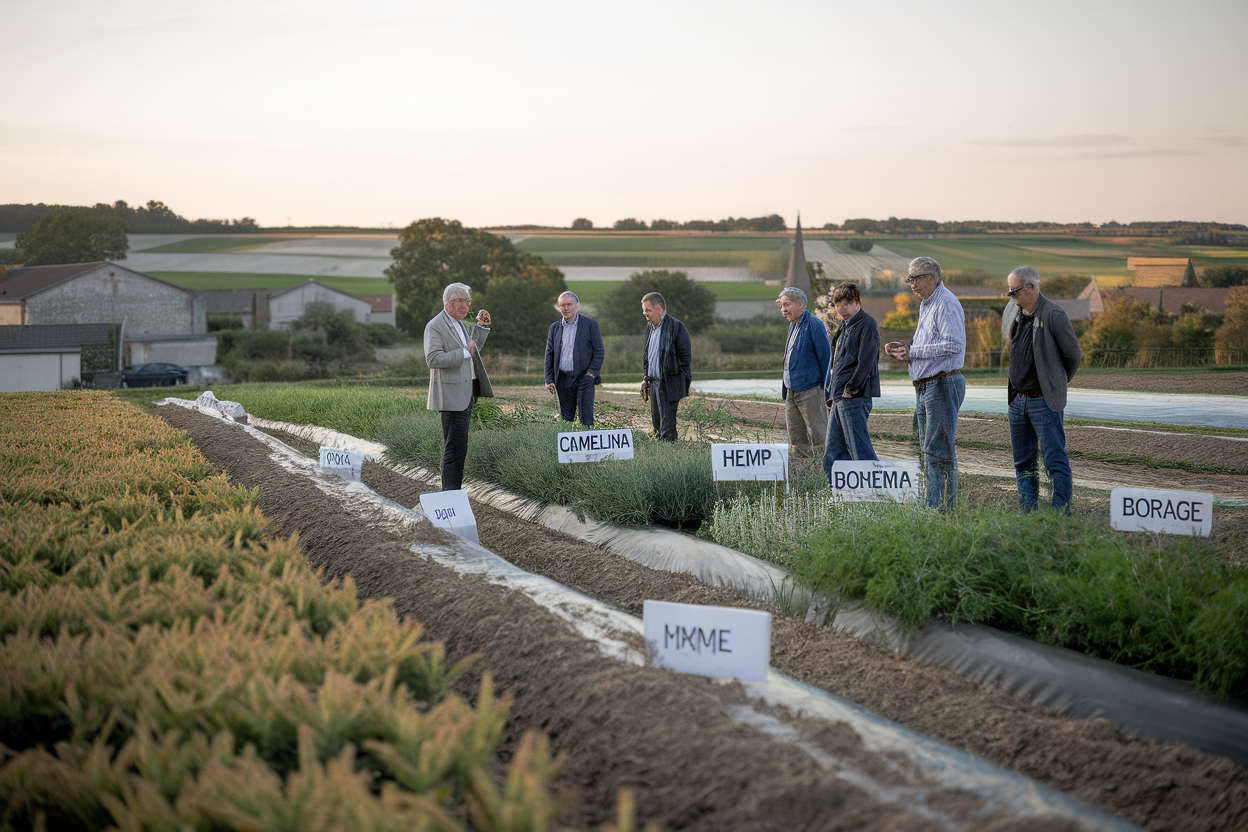
French farmers in the Indre department—think rural central France, a couple hours south of Paris—are doing something refreshingly unromantic: they’re planting weird stuff on purpose.
Not because it’s trendy. Because betting the farm on one crop and one buyer is a great way to end up broke when prices tank, weather turns nasty, or a processor changes the rules.
So the local farm bureau, the Chambre d’agriculture de l’Indre, is putting three “non-classic” crops on display—camelina, hemp, and borage—plus even peanuts in the mix. And they’re inviting working farmers to come look at the plots on June 9 in the village of Liniez.
A field day in Liniez: less talk, more dirt under the boots
The pitch is simple: stop arguing about “innovation” in conference rooms and go stare at the plants.
On June 9, the Indre chamber says it’ll walk visitors through its latest trials at Liniez—actual parcels, actual growing methods, actual observations. Farmers and advisers can swap notes the way they always have: standing at the edge of a field, squinting at what’s working and what’s failing.
The chamber’s own posts highlight trials involving peanuts, hemp, and borage. The point isn’t to sell anybody a fantasy. It’s to give farms options—either to diversify crop rotations or to chase new buyers when the old ones start squeezing.
Because in agriculture, a crop that looks great in a brochure is worthless until it survives local soil, local equipment constraints, local weather… and, most importantly, the local reality of “Who’s buying this, and for how much?”
Camelina and borage: oil crops with a catch—buyers have to show up
Camelina and borage aren’t being pushed because they’ll produce mountains of grain. They’re being tested because the money—if there is money—comes from niche oil markets that pay for specific uses and specific quality.
That’s the part a lot of diversification cheerleading skips. These crops live or die on the boring stuff: traceability, contracts, specs, collection logistics, processing capacity. You can grow the prettiest camelina in the county, but if there’s no serious chain from field to crusher to customer, you’re just raising an expensive conversation piece.
The chamber is effectively testing two things at once: whether the plants behave agronomically in Indre, and whether the economics are sturdy enough to matter. A “diversification crop” that can’t be sold reliably isn’t diversification—it’s gambling.
Established crops come with guardrails: calendars, standards, known buyers. Emerging crops force farmers to rebuild all of that from scratch. That’s usually where the dream dies.
Hemp is back—and it’s not just a local curiosity
Hemp gets special attention because it plugs into multiple industrial uses, especially fiber. And unlike some boutique oilseed experiment, hemp can connect to bigger, more industrial supply chains—if the region lines up the right partners.
This isn’t just an Indre thing. In neighboring Loir-et-Cher, the regional farm press Horizons reported a technical meeting held right in front of a hemp field between Séris and Avaray, hosted by a farmer named David Peschard. Same vibe: less theory, more “here’s what happened when we actually planted it.”
Farther east in the Meuse department, farmers are also trialing hemp after spring planting, tied to a partnership with an identified industrial player, La Chanvrière, according to La Gazette France. That comparison matters. Trials backed by a clear industrial buyer have a built-in advantage: the “who will purchase this?” question isn’t a shrug.
Hemp’s versatility is also its headache. Fiber markets aren’t all the same, and the specs can change depending on the end use. If you don’t know which market you’re growing for, you can end up with a crop that’s technically successful and commercially useless.
What the farm chamber is really selling: risk management, not novelty
The Chambre d’agriculture isn’t pretending a new crop is a magic trick. Its job—at least on paper—is to produce local references farmers can trust: what works, what doesn’t, what it costs, what it disrupts, and what it demands in labor and equipment.
Changing a rotation isn’t a hobby. It ties up cash, time, machinery, and sometimes long-standing relationships with buyers. When the chamber tests borage or hemp, it’s trying to turn “maybe” into something measurable: success conditions, red flags, fit with rotations, fit with a farm’s workload.
But the chamber can’t conjure a market out of thin air. The real make-or-break is whether a value chain forms—collection, processing, stable specs, and contracts that don’t leave farmers holding the bag.
And yes, peanuts show up on the chamber’s list too. That tells you something: they’re willing to explore ideas that sound odd for central France, without promising anybody a sudden gold rush. That’s the right posture. Trials are supposed to kill bad ideas quickly and elevate the few that can survive both the agronomy and the economics.
Indre’s bet: diversification as strategy, not a fad
Diversification comes in waves everywhere—usually when prices get ugly or a dominant crop starts failing farmers. What’s different in Liniez is the method: public trials, a set date, named crops, and an invitation to come judge with your own eyes.
The subtext is blunt: innovation doesn’t come from a memo. It comes from seasons of trial, farmer-to-farmer talk, and a hard look at whether the buyer side is real.
The big question hanging over the June 9 field day is the one farmers always ask first, even if nobody says it out loud: who’s ready to buy this stuff, under what terms, and with what kind of contract?
That’s where these projects live or die. And by putting “surprising” crops out in public, the Indre chamber is applying pressure where it belongs—on the region’s ability to turn experiments into a business that doesn’t collapse the first time the market sneezes.