

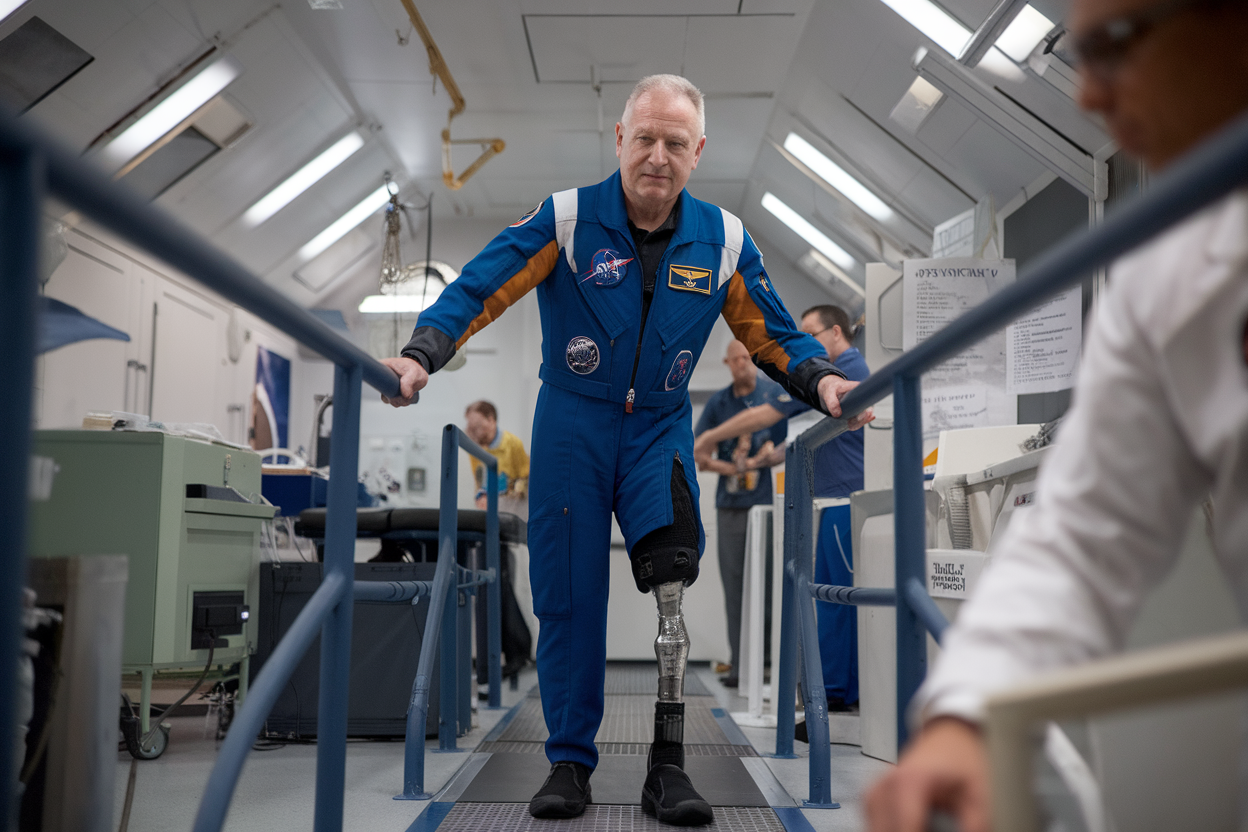
If the UK Space Agency gets its way, a British astronaut named John McFall could be headed to orbit as soon as 2027—on a mission tied to Vast, an American commercial space company. And if it happens, McFall wouldn’t just be another payload with a flag patch. He’d be the first person with a major physical disability to live and work in space for a long-duration mission.
That’s the headline-friendly version. The real story is messier—and way more interesting: space medicine has never had a chance to watch, in real life, what happens when an above-the-knee amputee with a prosthetic has to function in microgravity for months. Not in a lab. Not in a parabolic “vomit comet” flight. In orbit, where small problems turn into big ones because you can’t pop over to urgent care.
McFall lost his right leg above the knee in a motorcycle accident at 19. He went on to become a Paralympic sprinter, then a surgeon in Britain’s National Health Service (the NHS—basically the U.K.’s single-payer hospital system), and he’s now part of the European Space Agency’s astronaut reserve. ESA selected him in 2022. And in 2025, according to reporting on his physiological hurdles, he became the first person with this kind of amputation to be medically cleared for a long-duration space mission.
Samsung’s Galaxy Z Fold 8 leak: two AMOLED screens and a 5,000 mAh battery to flex on Apple
That clearance matters. It means the grown-ups looked at the risks—skin breakdown, equipment compatibility, emergency procedures, the whole ugly checklist—and decided this wasn’t a feel-good stunt.
Microgravity doesn’t “help” an amputee—it changes the whole problem
People hear “weightlessness” and assume it’s easier on the body. Sure, your joints aren’t pounding pavement. But astronauts’ muscles and bones weaken because they’re not carrying load. The body is built for gravity. Take gravity away and the system starts shedding capacity like a company doing layoffs.
For an above-the-knee amputee, the twist is this: a lower-limb prosthesis on Earth is designed to transfer force between the ground and the body through a socket around the residual limb. In orbit, you’re not “walking” in the normal sense. You’re pushing off handrails, bracing with footholds, rotating, stopping yourself from drifting into a panel full of expensive switches.
France Just Gave Wind and Solar a Fast Pass Around Local Zoning—Here’s the Catch
So the challenge isn’t body weight. It’s inertia—every shove has a consequence. And the movement strategies an amputee has trained into muscle memory on Earth (healthy leg, core, prosthetic working as a system) may behave differently when there’s no floor to save you with a quick stabilizing step.
Space physiologists want to know something basic that nobody’s been able to test on a real mission: does a body that’s already adapted to a human-machine interface—prosthetic + socket + learned compensations—adapt faster to microgravity? Or does it introduce new failure points?
The socket is the real villain: skin, sweat, swelling, and friction
A prosthetic leg isn’t like putting on a boot. It’s an intimate interface: skin and soft tissue pressed into engineered materials, with friction and shear forces that can chew you up if the fit is even slightly off.
France’s Big Tech Pitch at VivaTech: AI, Robots, and a Not-So-Subtle Swipe at U.S. Power
On Earth, irritation can be painful but manageable. In orbit, irritation can become operational. If the socket hurts, you may wear the prosthesis less. If you wear it less, you may lose stability for certain tasks. And if you lose stability, you start leaning harder on your arms and core—hello fatigue, hello overuse injuries.
Microgravity also shifts fluids in the body. That can change tissue volume, which can change socket fit. A fit that’s “fine” on the ground can turn into a pressure-point nightmare in space. This is the kind of unglamorous detail that decides whether a mission runs smoothly or becomes a daily grind of workarounds.
And then there’s hygiene and maintenance. Keeping skin healthy in a closed environment is already hard for astronauts. Add a prosthetic socket—where sweat, friction, and pressure meet—and you’ve got a new category of medical monitoring that spaceflight hasn’t had to deal with at this level.
Spacecraft are built for “standard bodies.” McFall forces engineers to get real.
Here’s the part nobody puts on the inspirational poster: space hardware is designed around assumptions. Handholds. Foot restraints. Launch seats. Space suits. Exercise machines. Emergency egress procedures. Everything quietly assumes a certain kind of body.
A prosthetic doesn’t automatically break those systems—but it can expose where the design is brittle. Maybe a foothold needs a tweak. Maybe a strap placement matters. Maybe a launch seat interface needs rethinking. In engineering, “small change” is usually a lie. One adjustment can ripple into training, safety certification, and how long tasks take when you’re exhausted and strapped for time.
If McFall flies, accessibility stops being a PR word and becomes an engineering requirement. That’s overdue.
Why McFall isn’t a mascot: he’s a surgeon and a former Paralympic sprinter
McFall’s résumé isn’t just “inspiring.” It’s practical. As a former Paralympic sprinter, he understands training, recovery, pain management, and the relentless optimization that elite performance demands. As an NHS surgeon, he’s used to high-stakes decision-making under pressure.
And the science angle gets even sharper when you talk about proprioception—your brain’s ability to sense where your body is in space. An above-the-knee prosthesis doesn’t come with biological sensors. The body learns to interpret indirect signals: pressure in the socket, muscle tension in the core, subtle cues from movement.
In microgravity, those cues change. Forces don’t come from the ground; they come from pushing off walls and grabbing rails. The brain has to recalibrate. Watching how McFall adapts could teach researchers what’s truly “human” about movement in space—and what’s just a byproduct of designs built for able-bodied astronauts.
Why 2027 matters: commercial space is rewriting who gets to fly
The UK Space Agency’s agreement with Vast points to a new reality: human spaceflight isn’t only the domain of NASA-style government programs anymore. National agencies are partnering with commercial players, and that changes timelines, mission architectures, and—potentially—who gets a seat.
McFall is 41 now, according to an Associated Press report carried by PBS News. ESA’s selection of him in 2022 was historic. But the bigger milestone may be the 2025 medical certification for long-duration flight. That’s where symbolism ends and risk math begins.
If the 2027 mission happens, it won’t just make a statement. It’ll generate hard data on how microgravity interacts with amputation and prosthetic use over months. And it’ll pressure spacecraft designers to treat accessibility like they treat radiation shielding or fire suppression: a real constraint, not a nice-to-have.
The lingering technical question is blunt: are the countermeasures astronauts already use—especially intense daily exercise—enough for a body whose mechanics have been rebuilt around a prosthetic? A mission like this could finally give a straight answer.
Sources
The reporting and background for this story draws from: The Conversation (“The extraordinary physiological challenges facing amputee John McFall in space”), Cité de l’Espace, PBS NewsHour/Associated Press coverage of ESA’s selection, and French disability-news coverage of McFall’s “parastronaut” milestone.