

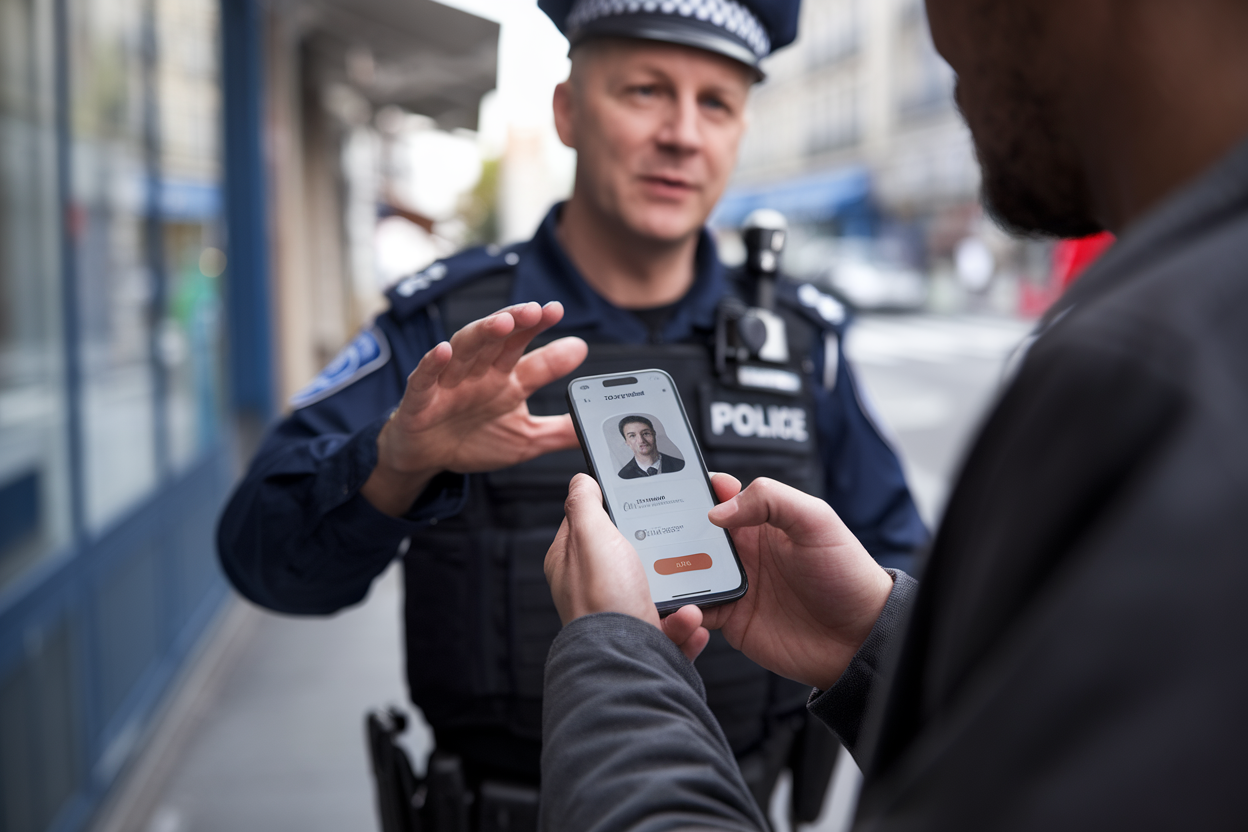
You left the house without your wallet. Again. No big deal—your phone pays for coffee, opens your car, and probably knows your blood type. So when a cop asks for ID, you do what every modern adult does: you flash a photo of your driver’s license or national ID and hope that’s good enough.
In France, that move might smooth things over. But legally? A photo is basically a convenience, not a credential. And the whole point of a police check is dead simple: confirm who you are, reliably. A JPEG doesn’t do “reliably.”
A photo of your ID is helpful—just not “official”
French outlet BFMTV put it plainly: a picture of your ID on your phone doesn’t count as presenting the actual document during a police check. It can help an officer look up information, sure. But it’s not the same thing as handing over the real card.
Why? Because a photo is a copy. Copies are easy to edit and hard to authenticate on sight. Think of it like showing a screenshot of a secure building badge. It might look legit. That doesn’t mean it is.
And people who’ve been through it say the same thing in less polished terms: sometimes the photo “works,” sometimes the officer asks for something else, and sometimes they keep digging until they’re satisfied. The issue isn’t what the photo shows—it’s what it can’t prove.
If you don’t have the physical ID, the stop can drag on
Here’s a key difference in French practice: not carrying an ID isn’t automatically the same as refusing to identify yourself. France doesn’t have a blanket rule that you must carry a national ID card at all times.
But don’t confuse “not required” with “no consequences.” If you can’t produce a real document, the officer may have to use other methods to verify you. That can mean a longer stop and more hassle, because the job isn’t to admire your lock screen—it’s to land on a confirmed identity.
TF1 Info and other French explainer pieces make the practical point: you might not get punished just for forgetting your papers, but having them makes the whole interaction faster and cleaner. The police aren’t hunting for a particular format. They’re hunting for certainty.
The real line you don’t want to cross: refusing to identify yourself
A phone photo can create a dumb misunderstanding: some folks think, “If I don’t have the physical card, I can just… not show anything.” That’s where you can get into real trouble.
The original context behind some of this chatter even referenced Spain—where refusing to provide identity information can be treated as a serious offense. That’s not a plug-and-play citation for French law, but the underlying idea travels well: forgetting your wallet isn’t the same as refusing to cooperate.
Bottom line: don’t use “I’ve got a photo” as a shield. If an officer asks you to identify yourself, the issue is cooperation and verifiable info. The photo might help. It doesn’t end the conversation.
When digital ID actually counts: official apps, official systems
Yes, digital ID can be legally equivalent to the physical document in some places—but only when it runs through an official government-backed app designed for that purpose.
That’s the whole technical point: an official app can include security features and verification tools—dynamic elements, back-end validation, anti-fraud checks. A photo is just a static file sitting on your phone.
It’s the difference between a train ticket inside an app with a scannable code and a photo of that ticket. One is built to be verified. The other is built to be… shown.
The downside nobody thinks about: you’re carrying a fraud kit
Keeping photos of identity documents on your phone isn’t just legally flimsy—it can be personally risky. Lose your phone, get it stolen, get it hacked, and now someone may have a clean image of your ID to use for scams and identity theft.
French reporting has also flagged another point that annoys people: sometimes officers photograph a driver’s license or document during a stop. Critics see it as some random cop snapping pics on a personal phone. But discussions (including on Reddit) suggest officers may use dedicated professional devices in some cases. That doesn’t automatically settle what’s appropriate in every situation, but it does explain why “they took a photo with a smartphone” isn’t always the full story.
Either way, the uncomfortable truth is this: an ID photo is easy to copy, easy to share, and easy to misuse. Convenience cuts both ways.
Two smart reflexes—and one false sense of security
The modern temptation is to treat your phone like a universal wallet and assume anything stored inside it carries the same weight as the original. That’s the trap.
Here’s the hierarchy the French sources lay out:
1) The physical document is still the gold standard.
2) A photo can help, but it doesn’t “count” as the document.
3) An official digital ID system—when it exists and is recognized—can be treated like the real thing.
So keep the photo if you want a backup. Just don’t confuse backup with proof.