

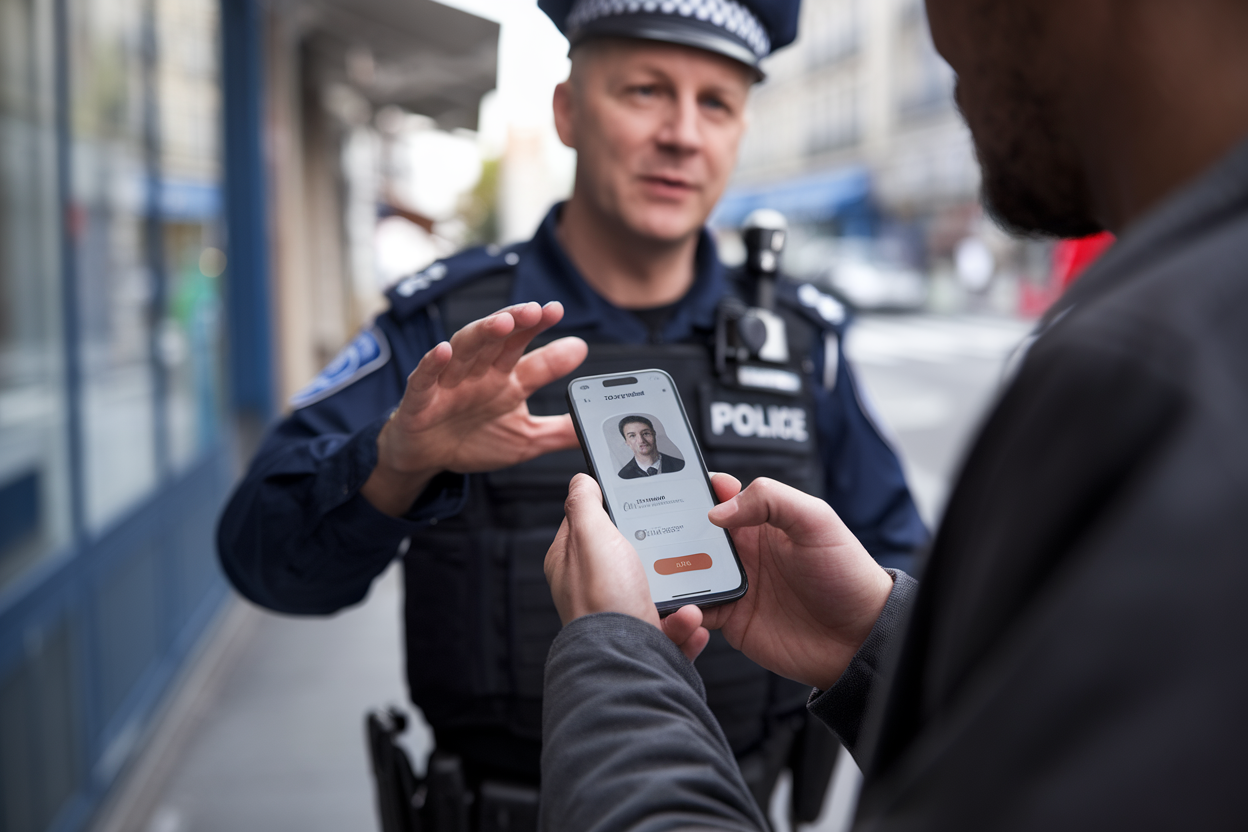
You left the house without your wallet. Big deal. Your phone pays for coffee, unlocks your front door, and probably knows your blood type. So when a cop asks for ID, the instinct is obvious: flash a photo of your driver’s license or passport and keep it moving.
Except a photo isn’t an ID. It’s a JPEG. And in the real world—where people fake things for a living—that difference matters.
A phone photo can help—but it doesn’t “count”
French outlet BFMTV put it plainly: a picture of your ID on your phone doesn’t equal presenting the actual document during a police check. It might help an officer look you up, but it doesn’t prove anything by itself.
Why? Because a photo is easy to doctor and hard to authenticate on sight. Think of it like showing a screenshot of a secure building badge. It may look legit. That doesn’t mean it is.
And people who’ve been through it say the same thing in legal forums: sometimes the photo smooths things over, sometimes the officer shrugs and asks for something else—or keeps digging until they’re satisfied. The key isn’t what the photo shows. It’s what it can’t guarantee: authenticity and integrity.
No ID on you doesn’t always mean a fine—just a longer, uglier stop
Here’s the part Americans might find surprising: in France, you generally aren’t required to carry a national ID card at all times. But if you don’t have a document on you, the stop can drag—because the officer still has a job to do: establish your identity reliably.
So the risk isn’t some philosophical “a photo isn’t valid.” The risk is practical: if they can’t confirm who you are, the verification process gets heavier. The photo becomes a clue, not proof.
TF1 Info’s consumer segment makes the same point in everyday language: forgetting your papers isn’t automatically punishable, but having proper ID makes the whole interaction faster and less painful. Police aren’t hunting for a file format. They’re hunting for certainty.
The real line you don’t want to cross: refusing to identify yourself
A phone photo can also feed a dumb misunderstanding: “If I don’t have the physical card, I can’t show anything.” Wrong move.
Forgetting your wallet isn’t the same as refusing to give your identity details when an officer requests them. The source material even nods to Spain, where refusal can be treated as a serious offense—different country, different statute, same basic idea: “I forgot my ID” doesn’t buy you the right to stonewall.
Bottom line: don’t turn the missing plastic into an attitude. Cooperation matters, and the officer can still run checks or demand other ways to confirm who you are.
When digital ID actually works: official apps, official systems
Yes, digital ID can be legally equivalent to the physical document—when it’s delivered through an official government app designed for that purpose.
That’s the whole point: an official app can include security features a photo can’t—dynamic elements, back-end validation, anti-fraud checks. A photo is static. It’s the difference between a scannable mobile train ticket and a picture of someone else’s ticket. One is built to be verified. The other is built to be forwarded.
So when someone says, “But I have it on my phone,” the real question is: do you have an official digital credential—or just an image file?
The downside nobody thinks about: you’re carrying a fraud kit
Keeping photos of your ID on your phone isn’t just legally flimsy—it can be personally reckless. Lose your phone, get it stolen, get it hacked, and now your identity document is floating around as a convenient attachment.
A French report about people getting irritated when police photograph a driver’s license makes a blunt point: it’s easy to have a photo of anyone’s ID on a phone. Images travel fast and get reused fast.
There’s also confusion about what officers are doing when they “take a photo.” Some discussions suggest police may use dedicated professional terminals rather than a personal phone. That doesn’t magically settle every legal question, but it does explain why what looks like casual snapping might actually be part of standard procedure.
The two smart reflexes: carry real ID—or use real digital ID
The smartphone-as-wallet fantasy leads people to a comforting lie: “If it’s on my phone, it’s basically the same as the original.” It isn’t.
Here’s the hierarchy the French sources lay out, and it’s common sense anywhere:
1) Physical document = the gold standard.
2) Photo of the document = sometimes helpful, never definitive.
3) Official digital ID (where available) = can be treated like the real thing because it’s built to be authenticated.
If you want fewer headaches, treat that ID photo like a spare tire: nice to have, not something you want to drive on every day.