

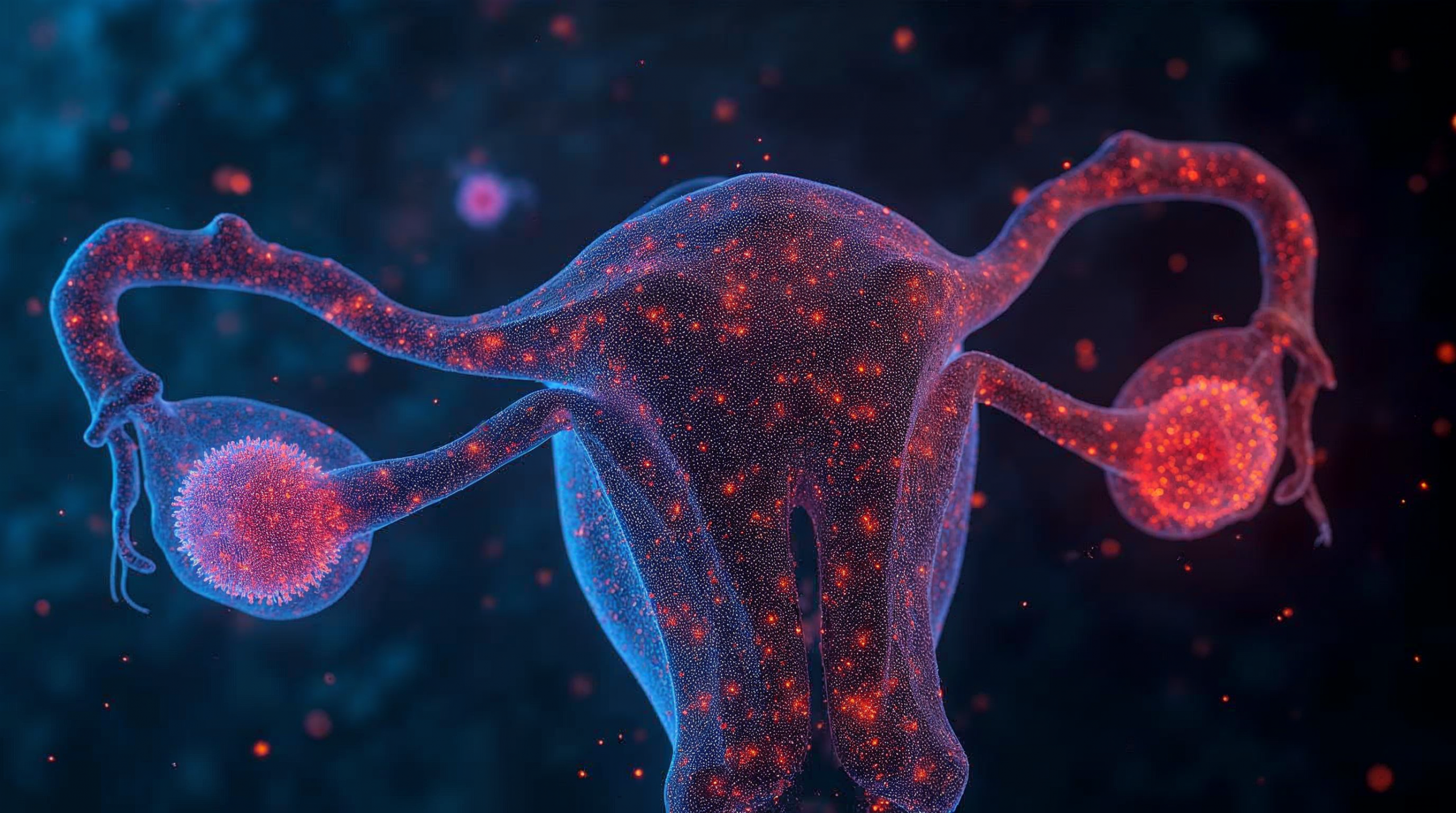
Pregnancy is the most studied “mystery” in medicine: everybody thinks we’ve got it mapped, and then—surprise—there’s a whole cell type nobody’s seen before.
Researchers at UC San Francisco say they’ve identified a previously unknown human cell that shows up for a fleeting moment at the very start of pregnancy, right where mom’s tissue and the embryo’s tissue meet. Their best guess: it acts like a bouncer at the door while the placenta starts wiring itself into the mother’s blood supply.
And here’s the twist that’ll get attention in any American waiting room: this cell carries a receptor tied to cannabinoids—the same biological system that responds to THC.
A high-res map of where mother and fetus actually meet
The UCSF team built what amounts to a cellular street map of the maternal–fetal interface—the contact zone where implantation, immune tolerance, and early placental construction all collide. This is also the spot where outside exposures can matter, because it’s influenced by what’s circulating in blood, what’s inhaled (smoke included), and what people swallow under the “natural remedy” label.
To pull it off, they combined two heavy-duty methods: single-cell sequencing (to identify cell types) and spatial mapping (to keep cells in their original neighborhoods so you can see who’s next to whom and likely interacting).
The scale is the flex here. They analyzed about 200,000 cells one-by-one, then cross-checked against nearly 1 million more cells mapped in place. The samples span roughly week 5 through week 39 of pregnancy—basically from early first trimester to full term.
The takeaway is humbling: even in a process as fundamental as pregnancy, we’re still filling in blank spaces on the map.
Meet DSC4, a cell that appears early—then vanishes
Buried in that cellular census was a subgroup the researchers say didn’t show up in prior placental studies. They named it decidual stromal cell 4, or DSC4.
What makes DSC4 weird isn’t just that it’s “new.” It’s that it seems to be a mayfly: observed only at the very beginning of pregnancy and then not detected later on. That kind of timing screams “special assignment”—a job that matters for a narrow window, then ends.
But the researchers aren’t pretending they’ve solved it. Senior author Jingjing Li described asking other experts what these cells were and getting the blunt reply: “no one knows what they are.” You don’t hear that kind of honesty often in biomedical science, and you should take it as a sign that early pregnancy biology still has plenty of dark corners.
The cannabinoid clue: DSC4 expresses CNR1 (the CB1 receptor gene)
The paper, published in Nature, offers one concrete lead: DSC4 expresses CNR1, the gene that codes for the cannabinoid receptor CB1.
CB1 responds to cannabinoids your body makes on its own—and also to THC from cannabis. That doesn’t mean “weed causes X” (slow down), but it does mean this newly spotted cell is wired into a chemical signaling system that can be influenced internally and, potentially, externally.
One caution the authors effectively build in: seeing a gene and a receptor doesn’t hand you the full instruction manual. It’s a marker, not a verdict. Still, it’s a real, testable handle for tracking these cells and figuring out what they’re doing.
Lab tests hint at a braking system on fetal cell invasion
The team also ran lab experiments that point in a specific direction. Cannabinoid signals appeared to slow the normal “invasion” of fetal cells into the uterus.
That invasion is a big deal. Early on, fetal cells have to push into maternal tissue so the placenta can anchor and connect to maternal arteries. Too aggressive and you can imagine problems; too weak and you can also imagine problems. The whole thing is a biological high-wire act.
If DSC4 is part of that early braking-and-balancing system, its short-lived appearance starts to make sense: show up when the connection is being established, help set the limits, then disappear once the basic architecture is in place.
The researchers stop short of declaring DSC4 the master regulator here. Fair. Right now, it’s a strong observation paired with suggestive experiments—not a final answer.
A gorgeous map isn’t a medical test—yet
Cell atlases are scientific gold because they let researchers compare normal pregnancies to complicated ones, spot cellular “signatures,” and connect exposures to specific tissues at specific times. The UCSF approach is especially useful because it links cell identity with cell location—who’s talking to whom, and where.
But let’s not oversell it: a map doesn’t prove cause and effect. This study puts three things on the table—an apparent new cell type (DSC4), a molecular marker (CNR1/CB1), and lab data consistent with a role in controlling fetal cell invasion. The next steps are the unglamorous ones: replication, pinning down function, and figuring out how this signal fits into the rest of implantation biology.
For now, the cleanest headline is scientific: the inventory of human cell types at the maternal–fetal interface just got bigger, and one of the new entries seems to show up only in the earliest days—right when the placenta is making its first, critical connection.