

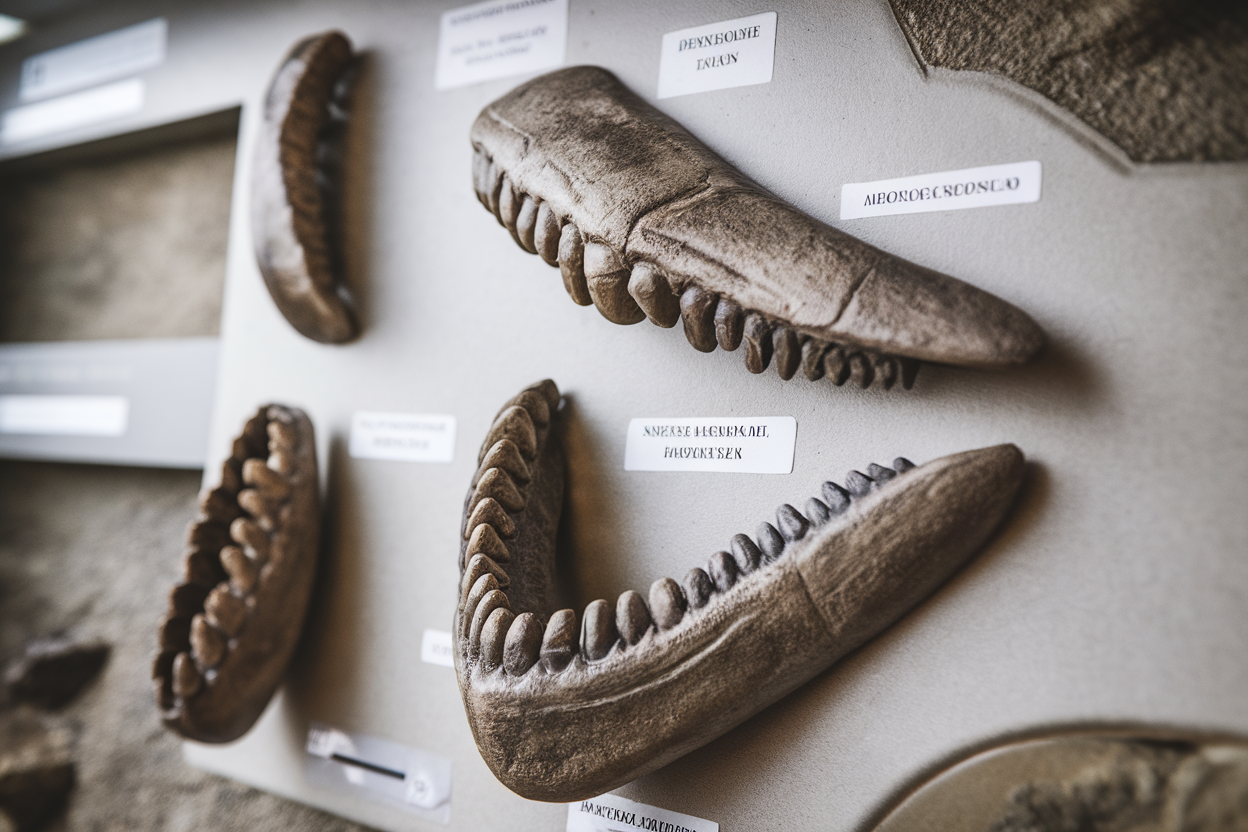
Picture a critter about three feet long, hanging around ancient Brazilian wetlands, chewing plants with teeth that don’t even point up.
That’s the gist of a new fossil description published March 4, 2026: nine lower-jaw specimens from northeastern Brazil that belong to a previously unknown animal, Tanyka amnicola, dated to roughly 275 million years ago. No glamorous skull. No full skeleton. Just jaws—warped in a way that makes some teeth aim sideways. And that weird little detail is exactly why paleontologists are paying attention.
Nine fossil jaws, one stubborn mystery
The material comes from the Pedra de Fogo Formation, a well-known fossil-bearing package of rocks in Brazil that preserves ancient inland ecosystems—freshwater lakes, marshes, floodplains. The researchers argue that even without a complete skeleton, a consistent set of jawbones can be enough to call a new species, as long as the anatomy repeats and doesn’t look like random damage from being crushed underground.
That’s the key here: the same basic jaw pattern shows up across nine separate specimens. The team says they considered the obvious explanation first—geologic distortion, the fossil equivalent of a car wreck. But the twist appears consistent, and the way the teeth sit in the bone looks deliberate, not accidental.
If their read is right, Tanyka wasn’t some one-off freak. It was built this way.
The jaw twist that makes the teeth point sideways
Most vertebrates keep their teeth oriented for a pretty straightforward job: bite down, slice, puncture, grind. Teeth generally point up toward an opposing jaw. Tanyka breaks that basic expectation. Parts of the lower jaw are twisted enough that some teeth angle laterally—out to the side.
That changes the whole mechanical story. Sideways-oriented teeth hint at a different kind of bite—maybe a lateral shearing motion, maybe scraping, maybe gripping vegetation arranged in a way where “up-and-down” isn’t the best move. The paper treats herbivory as a reasonable hypothesis, based on the dentition and the wetland setting, but it doesn’t pretend the case is closed. Without a skull, you’re still guessing about the full toolkit—jaw muscles, bite force, how the upper teeth (if any) matched up.
And yes, there’s always the “could this be disease or injury?” question. A single twisted jaw could be a pathology. Nine similar jaws are harder to wave away.
A “living fossil” from its own time—on a branch outside modern tetrapods
The authors place Tanyka amnicola on the stem of the tetrapod family tree—outside the later lineages that lead to modern amphibians, reptiles, birds, and mammals. Translation for normal people: this thing isn’t your ancestor. It’s an old, distant cousin from a side branch that ultimately died out.
Jason Pardo, the paper’s first author, uses the phrase “living fossil,” and he’s not saying it didn’t evolve. He’s saying something more interesting: even 275 million years ago, there were still very archaic tetrapod lineages hanging on in Gondwana (the southern supercontinent that included what’s now South America, Africa, Antarctica, Australia, and India). And they weren’t just limping along. They were still experimenting—at least anatomically—with odd solutions like a twisted jaw and sideways teeth.
This is also a reminder that the fossil record isn’t owned by the usual celebrity sites in North America and Europe. Brazil’s inland deposits keep coughing up animals that complicate the tidy, textbook version of early land-vertebrate evolution.
A three-foot wetland herbivore—maybe
Based on the jaws and the geology, the team thinks Tanyka lived around freshwater—lakes or wetlands—and reached about 0.9 meters long, roughly three feet. That’s not a monster, but it’s big enough to matter in its ecosystem: a mid-sized plant-eater (if that’s what it was) that could’ve fed on shoreline vegetation or aquatic plants.
If the herbivore idea holds up, it also nudges the picture of these ecosystems away from the usual predator-heavy storytelling. Plant-eaters are the infrastructure. You don’t get a stable food web without somebody doing the unglamorous work of turning greenery into meat.
The catch is obvious and the researchers admit it: right now, this animal is basically a jaw with a name. The next breakthrough will require more bones—skull pieces, vertebrae, limb elements—to confirm how it moved, how it fed, and where it sits with more confidence on the tetrapod tree.
Still, paleontology runs on fragments. And a jaw that refuses to behave like a normal jaw is exactly the kind of fragment that can rewrite a chapter.