

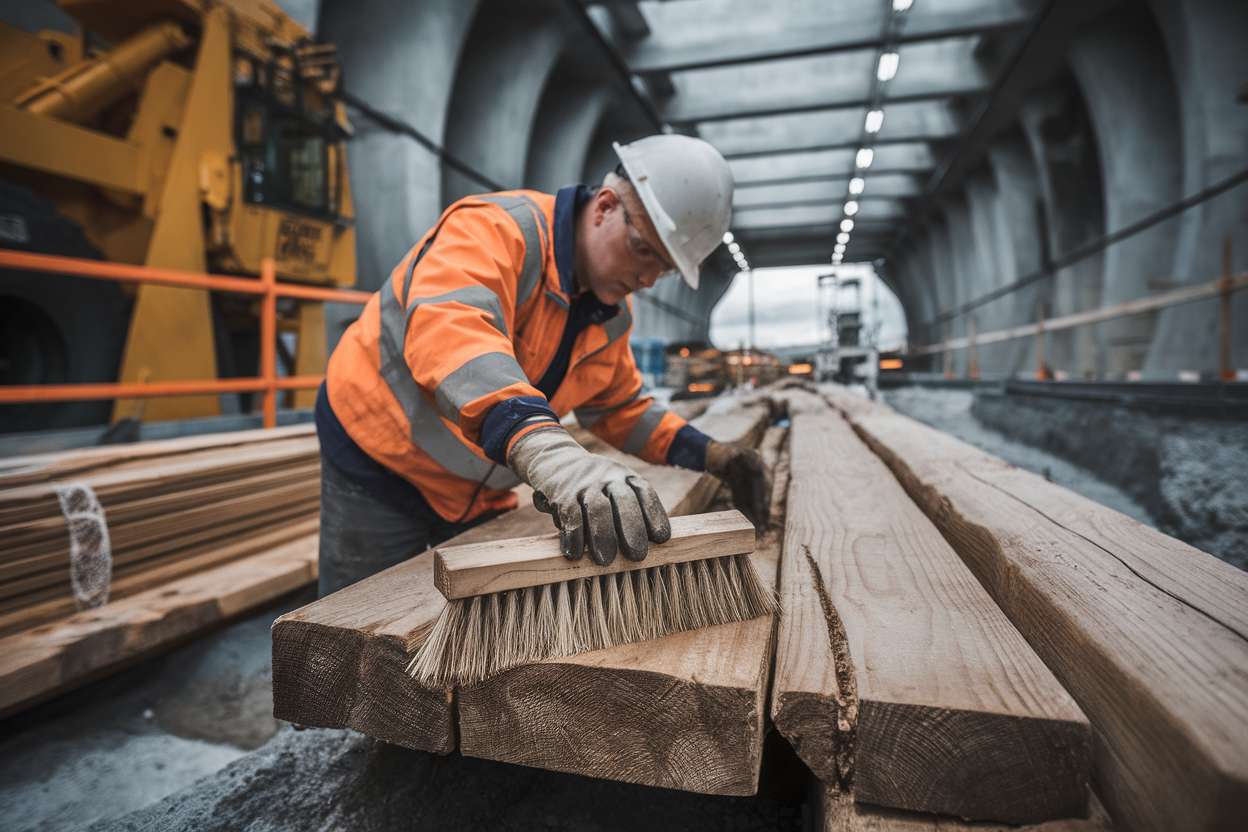
Varberg, Sweden, is trying to do what every growing place tries to do: move people faster, cut delays, and stop trains from clogging up the surface streets.
And then the ground started coughing up boats.
Not a stray plank or two—six shipwrecks, buried under land that didn’t even exist back when those vessels were working the waterfront. The finds popped up during construction of the Varberg Tunnel, a major rail project in this coastal town in southwest Sweden. Archaeologists working alongside the builders realized they weren’t just digging through dirt and fill. They were slicing into an old port that the modern city had basically paved over.
A commuter rail project that accidentally reopened Varberg’s shoreline
The Varberg Tunnel is part of Sweden’s effort to expand the West Coast Line. The Swedish Transport Administration says the plan includes about 9 kilometers of new double track—roughly 5.6 miles—and a rock tunnel about 2.8 kilometers long, around 1.7 miles, running under Varberg.
The pitch is familiar: smoother service, fewer delays, less surface disruption near the station. But here’s the twist Americans might miss if they’ve never watched a European port city reinvent itself: parts of Varberg sit on land that was filled in starting in the 1800s. So what looks like ordinary downtown real estate can be yesterday’s harbor—sealed under layers of dumped material and urban expansion.
That’s why “preventive archaeology” in places like this isn’t some museum-world luxury. It’s damage control for history. If you don’t look before you pour concrete, you lose the record forever.
Six wrecks spanning from the Middle Ages to the 1600s
The wrecks were spotted during archaeological work that began in 2019, in and near Varberg’s historic center. Researchers dated four of the wrecks to the Middle Ages or late medieval period, one to the 17th century, and one couldn’t be dated.
These weren’t royal warships or storybook galleons. The teams describe them as work boats—the kind of vessels that hauled goods, serviced a harbor, and kept a coastal economy running. Which is exactly why they matter. Fancy ships get paintings. Working craft get forgotten… until a rail trench finds them.
There’s also the brutal reality of doing archaeology inside an active construction zone: you’re moving fast or you’re not moving at all. What comes up can be scattered hull sections, ribs, and waterlogged wood in mixed condition depending on moisture, sediment, and whatever later development did to the site.
A 2025 report zooms in on three wrecks with the best surviving structure
A 2025 report focused on Wreck 2, Wreck 5, and Wreck 6, written by Elisabet Schager with co-authors Anders Gutehall, John Evan Skole, and Edgar Wrblewski. The reason for the narrow focus is practical: those three had structural elements intact enough to actually tell a clear story, even if the remains were fragmentary.
The fieldwork pulled in maritime and archaeology specialists from Bohuslän Museum, Visual Archaeology, and Cultural Environment Halland. That kind of collaboration isn’t academic politeness—it’s survival. Waterlogged wood can start falling apart fast once it’s exposed, and if you botch the documentation or conservation steps, you’ve basically turned a 500-year-old artifact into mulch.
Schager, quoted in the report, said, “It will be very interesting,” adding the team expects “a lot of exciting things” as remaining analyses move forward. It’s a restrained Scandinavian way of saying: we’ve got a lot more to learn from these timbers—how they were built, where the wood came from, and what happened to the boats before they ended up entombed under a city.
Wreck 2: an oak sailing vessel built in the late 1530s—with burn marks
The headliner is Wreck 2, identified as an oak sailing vessel built in the second half of the 1530s, using timber sourced from western Sweden. Archaeologists recovered two connected hull sections on the starboard side, plus scattered timbers—making it the most continuous structure of the bunch.
It was built using clinker construction, where planks overlap like shingles. If you know Viking ships, you know the vibe: it’s a classic northern technique for tough, flexible hulls. For archaeologists, it’s also a fingerprint—overlaps, fasteners, reinforcements, and framing choices can be compared with other regional builds to narrow down traditions and influences.
Then there’s the detail that makes this wreck feel less like a textbook diagram and more like a crime scene: researchers found burn traces on a protective strip along the hull. The report suggests the vessel may have been burned before it sank, but nobody’s pretending they’ve nailed down the why. Accident? Intentional destruction? Some dockside mishap? Later damage that only looks like fire? The next round of analysis will decide which theories survive.
The fact that parts of the hull were still connected matters, too. It hints the wreck was buried in a way that protected it—or that it wasn’t immediately smashed apart by waves, salvage, or demolition. In an old harbor environment, the endings are messy: grounding, partial dismantling, slow submersion, or rapid burial by sediment long before the 1800s fill buried everything under “new” land.
What these wrecks say about the port Varberg forgot it had
The real punch of this story isn’t just “cool shipwrecks.” It’s where they were found: under parts of a modern city built outward onto former waterfront, especially since the 19th century. The tunnel project is basically cutting a cross-section through Varberg’s urban history.
Six wrecks spread across centuries suggest a shoreline that stayed busy for a long time, even as the coast shifted and the town reshaped itself. The presence of a 1600s vessel alongside medieval remains hints that the same zone stayed active—or got reused—through major changes in the harbor and coastline.
And here’s the part that should land with Americans who’ve watched “revitalization” bulldoze local memory: working boats rarely get the attention given to warships or famous explorers. But they’re the real infrastructure of daily life—moving supplies, feeding markets, keeping trade humming. When you find them, you’re not just finding wood. You’re finding the operating system of an old port.
The trains will keep coming. The tunnel will get built. But Varberg’s soil just delivered a reminder: development doesn’t erase history. It just buries it—until the next big project digs it back up.