

Hyundai just walked into Beijing and did something foreign automakers usually avoid in China: it stopped pretending the country is just a place to “localize” global cars.
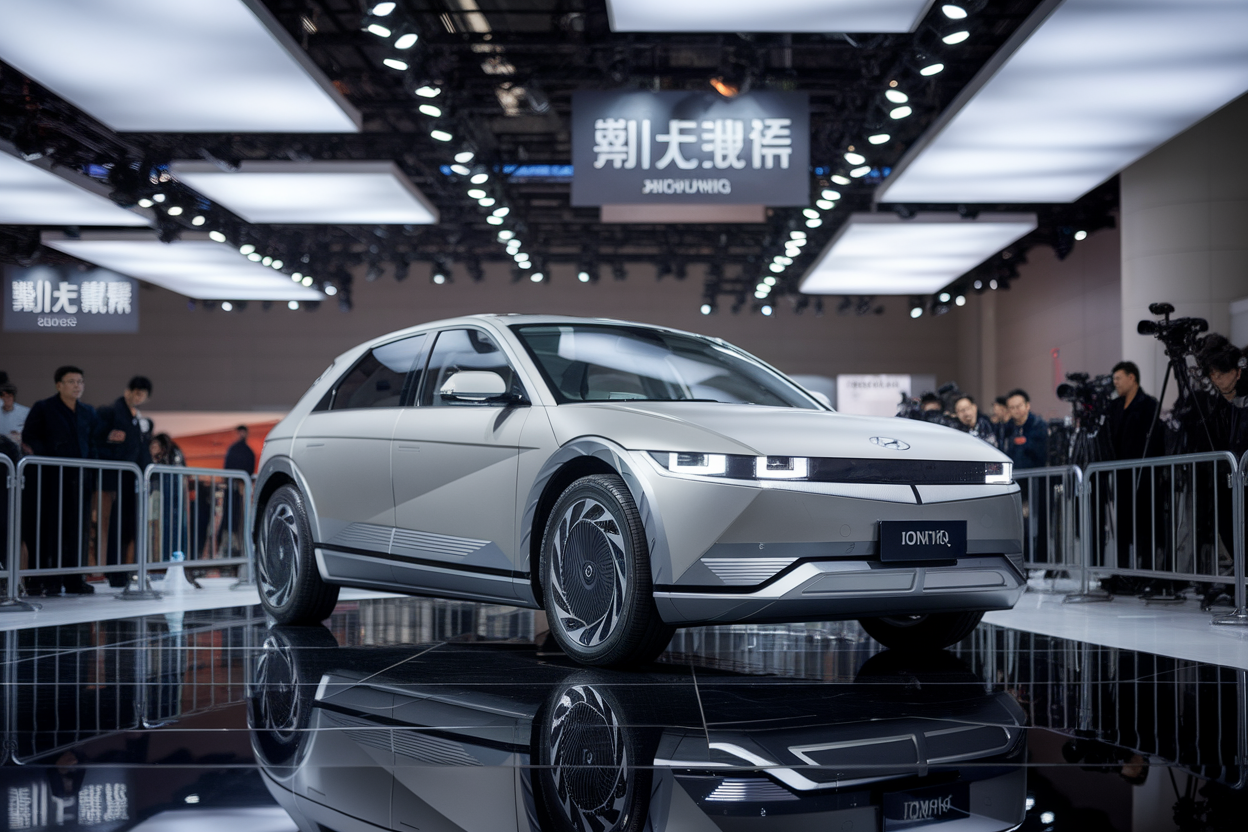
At Auto China 2026, the company rolled out a new, China-first electric brand push—IONIQ—right alongside its long-running joint venture badge, Beijing Hyundai. And it brought a new vehicle to make the point: the IONIQ V, unveiled in Beijing as a world premiere.
The slogan is blunt enough to be a warning label for rivals: “In China, For China, To Global.”
Two badges, one message: Hyundai wants a clean break from its old China image
Here’s the architecture: Beijing Hyundai stays as the mainstream, legacy umbrella. IONIQ becomes the dedicated all-electric banner.
That split isn’t just marketing fluff—it’s damage control. Gas-powered lineups age fast, and in China they can drag a brand’s “modern” credibility down with them. Hyundai’s trying to keep its EV future from getting stained by the perception of yesterday’s internal-combustion inventory.
And it’s also a signal to the market: Hyundai wants to look like it’s building EVs the way Chinese buyers expect—fast product cycles, heavy software, and design that doesn’t feel like it came out of a global committee meeting in Seoul.
Meet the IONIQ V: a “normal person’s Cybertruck” vibe, built for China first
Hyundai says the IONIQ V is a production model, closely tied to its earlier Venus concept. Translation: this isn’t some auto-show sculpture that disappears into a warehouse after the lights go out.
Visually, it’s all wedge shape and sharp edges—aggressively geometric without going full stainless-steel cosplay. The easiest shorthand is a Cybertruck look for people who still want a car that fits into regular life.
Hyundai is also using the V to debut a new design language it calls “The Origin.” In China’s EV arena, design isn’t a nice-to-have; it’s a quick way to telegraph “new” before anyone even taps the screen or checks the spec sheet.
“In China, For China, To Global” is Hyundai admitting where EV speed lives now
Hyundai’s tagline is basically an acknowledgment of the obvious: China is where EV iteration happens at street speed—batteries, suppliers, software updates, digital dashboards, driver-assist features, the whole arms race.
By treating IONIQ as a locally driven EV brand identity (not just a model line shipped in from elsewhere), Hyundai gives itself room to make faster calls on interface design, in-car tech, and feature content without waiting for global alignment.
And yes, it’s also a competitive response. Chinese brands have built their edge on tight integration, short development loops, and digital experiences that feel native to local habits—especially smartphone integration and driver-assistance packaging.
Hyundai’s own language hints at a reset: this is meant to relaunch its EV effort in China, which is a polite way of saying the earlier phase didn’t land like they wanted.
Hyundai’s big promise: 20 new models in five years—and 600+ km of rated range
The IONIQ V is supposed to be the first tile in a much bigger mosaic. Hyundai says it plans to introduce 20 new models in China over the next five years. That’s an ambitious cadence in a market where “new” expires quickly and showroom traffic follows novelty.
On range, Hyundai is talking about a long-range IONIQ V variant targeting more than 600 km on China’s CLTC test cycle—about 373 miles. Americans should treat that number the way we treat optimistic EPA window stickers from a decade ago: useful for comparison, not gospel for real-world driving.
In China, range is table stakes anyway. Buyers also care—sometimes more—about charging performance, software smoothness, driver-assist behavior, and whether the car’s digital life plays nicely with the phone in their pocket.
One more nuance that matters: Hyundai has built China-specific vehicles before, but this is the first IONIQ-branded production model developed specifically for China. That’s a shift in center of gravity—less “here’s what we made globally, with tweaks,” more “we’re starting here.”
The real test won’t be the applause in Beijing. It’ll be whether Hyundai can follow the IONIQ V quickly with more launches—priced right, loaded with the right tech, and sold through a distribution setup that can survive against local competitors who refresh their lineups like it’s a software release cycle.