

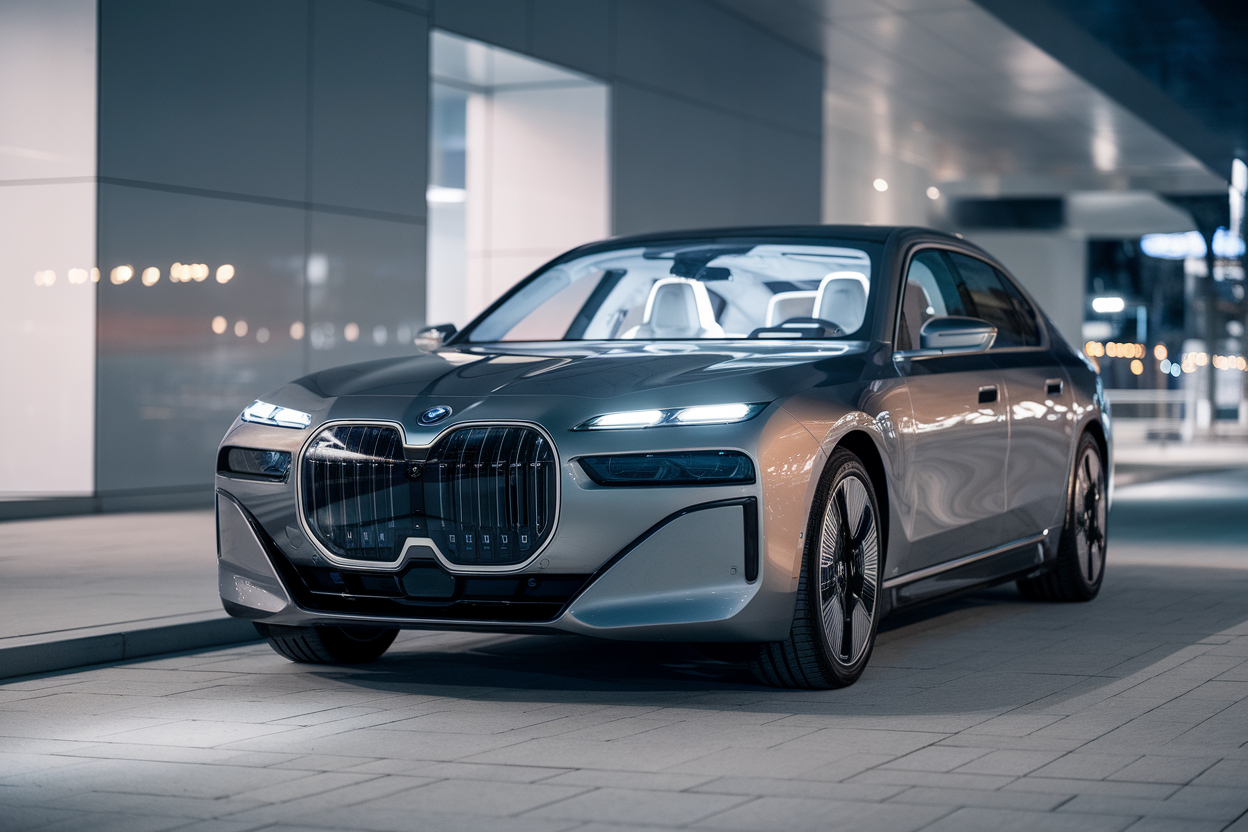
BMW is giving its flagship sedan the kind of overhaul you reserve for the stuff that actually matters. The next big refresh of the 7 Series—headlined by a heavily updated all-electric i7 for 2027—was rolled out at events in New York and Beijing with a blunt message: the luxury sedan is now a rolling software lab.
And BMW isn’t pretending this is just about horsepower anymore. In the premium EV world, bragging rights increasingly come down to the human-machine interface—how the car talks to you, how it updates, how it helps (or nags) you—every bit as much as how fast it launches.
Neue Klasse finally lands on the 7 Series—and it’s not a cosmetic job
BMW first teased its “Neue Klasse” platform back in 2021. For years the obvious question hung in the air: when does the tech hit the mothership?
Answer: now. The refreshed 7 Series is being positioned as a Neue Klasse-era car, built around a more software-forward approach—deeper remote updates, tighter integration of digital assistants, and an electrical architecture meant to support that kind of always-evolving feature set.
Under the skin, BMW says the i7 moves to a new battery and drivetrain setup derived from its sixth-generation eDrive tech, developed specifically for Neue Klasse vehicles. Translation: they’re trying to modernize the fundamentals, not just bolt on bigger screens.
Yes, it gets the Neue Klasse styling cues too—reworked grille, new headlights, revised rear lighting signature. The goal is to telegraph “new generation” without turning the 7 Series into a design science project.
Panoramic Vision and “shy tech”: BMW wants the cabin to chill out
The loudest change is inside. BMW’s “Panoramic Vision” is a full-width projection area at the base of the windshield, stretching across the dash. The pitch is simple: put key info in your line of sight without stacking yet another iPad on the center console.
That’s a direct shot at a growing complaint in luxury cars: too many screens, too many menus, too much visual noise.
BMW is also pushing what it calls “shy tech”—a design philosophy where sensors and hardware elements stay visually hidden until they’re needed. It’s an interesting flex. Instead of screaming “LOOK, TECHNOLOGY,” the car tries to fade it into the background when it’s not helping. In high-end cars, that kind of restraint can read as status: the tech is there, but it doesn’t have to perform for you.
The interface layout reflects that hierarchy. Driving essentials—speed, battery status—sit directly in front of the driver. Media and other services live around a big central display, with a digital assistant avatar hovering as the gateway to functions.
A 17.9-inch center screen turns the cockpit into a software product
BMW’s new center screen is a 17.9-inch hexagon-shaped display that runs infotainment and a growing list of vehicle functions. The screen isn’t just a screen anymore—it’s the organizing principle of the front cabin.
And BMW is leaning hard into centralized computing—what it calls “superbrains”—to power advanced features, including an AI-boosted voice assistant.
One notable choice: Alexa Plus integration for voice control. BMW’s basically admitting it doesn’t need to build every piece of the digital ecosystem itself. For buyers, the promise is convenience—talk to the car, hand off settings, and keep some continuity between your phone, your smart home, and your vehicle.
Of course, this whole strategy only works if the car keeps improving after you drive it off the lot. BMW is betting on over-the-air updates to keep the software current—because nothing kills the vibe of a six-figure luxury sedan like a UI that feels three years old.
Auto lane changes and self-parking: the arms race is about smoothness, not checkboxes
Driver assistance is the other pillar here. BMW is touting features like automatic lane changes and automated parking—exactly the stuff you want when you’re piloting a big, expensive sedan through tight city streets or grinding out highway miles.
But the real competition isn’t “does it have the feature.” It’s whether the system feels calm and trustworthy: clear prompts, well-tuned alerts, and handoffs that don’t spike your blood pressure. That’s where BMW’s “shy tech” idea matters—assistance that’s present without turning the cabin into a cockpit from a bad sci-fi movie.
To pull it off, BMW is leaning into more centralized onboard computing and an electrical architecture designed to handle more sensors and more processing without stuffing the car with a chaotic mess of separate control boxes.
i750 at 449 hp, i760 at 536 hp: yes, BMW still cares about the power ladder
Don’t worry—BMW isn’t abandoning its familiar hierarchy. The refreshed electric lineup keeps dual-motor, all-wheel-drive variants, split cleanly by output: the i750 is rated at 449 horsepower, while the i760 jumps to 536 horsepower.
The two-motor AWD setup isn’t just about bragging rights. On a heavy, torque-rich luxury EV, it’s about putting power down smoothly and keeping the car stable. Raw speed isn’t the only selling point in this class anymore, but it’s still a status signal—and it still matters for effortless passing and that “I paid for the top trim” feel.
Still, the biggest changes are clearly in the cabin. BMW’s telling you where the value is headed: less about the drivetrain as a headline, more about the interface, the services, and the sense that the car won’t feel digitally ancient halfway through your lease.
BMW’s real bet: luxury sedans now live or die by the interface
Turning the 7 Series into a Neue Klasse showcase isn’t subtle. In flagship sedans, buyers expect tech that feels inevitable: ambitious head-up-style displays, voice controls that don’t embarrass themselves, driver aids that feel reassuring, and updates that keep coming.
BMW is also stressing that this i7 refresh goes deeper than surface-level gadgetry, with a new battery and motor architecture meant to support the next decade of software-driven features.
The tricky part is the balancing act. In a car where silence, comfort, and perceived quality are still the whole point, there’s a fine line between “smart luxury” and “rolling control room.” BMW’s answer—at least on paper—is Panoramic Vision plus shy tech: put the technology everywhere, and show it less.