

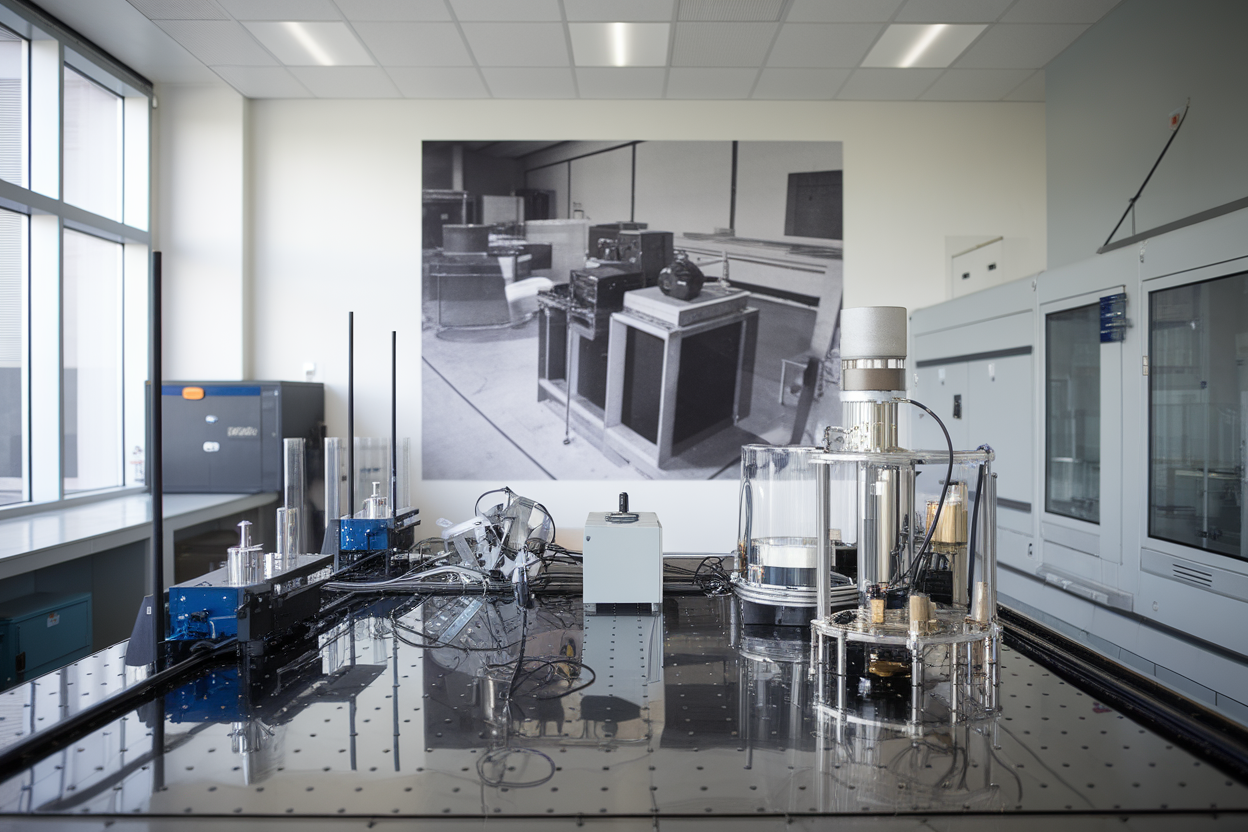
Computing started at the University of Pennsylvania with a room-sized beast called ENIAC. Now Penn researchers are back with a new obsession: ditching the humble electron—because it’s turning into a bottleneck—and doing certain kinds of computing with weird hybrid particles made of light and matter.
Yeah, it sounds like sci-fi. But the motivation is painfully practical: electrons run hot, they hit resistance, and they get harder to corral as chips cram in more transistors and shove around more data. The physics doesn’t care how slick your marketing is.
ENIAC’s ghost still runs the show—and that’s part of the problem
Back in the mid-20th century, Penn engineers J. Presper Eckert and John Mauchly helped kick off electronic computing by harnessing electrons in ENIAC, often described as the first general-purpose electronic computer. Different era, same basic deal: modern computers still lean on architectures built around moving electrical charge through materials.
Bredewold Muscles Up and Wins Stage 1 of the Women’s Basque Tour—Message Sent
That continuity is impressive. It’s also a trap. When your entire industry is built on pushing electrons through ever-tinier pathways, you inherit every nasty side effect that comes with charged particles moving through real-world stuff.
Electrons: the original workhorse, and a chronic heat problem
Electrons carry electric charge. That’s the whole point—and the whole headache.
Move charge around and you bleed energy as heat. That heat isn’t a rounding error; it’s one of the reasons laptops throttle, data centers guzzle power, and chip designers spend their lives playing thermal whack-a-mole.
Trump’s ethics filing shows a dizzying number of U.S. stock trades—and it’s a bad look
Then there’s resistance. Even in beautifully engineered materials, electrons don’t glide like Olympic skaters. They collide, they scatter, and the signal pays a tax.
And as chips pack in more transistors and process bigger rivers of data, managing all that behavior gets uglier. Not “philosophically challenging.” Physically messy.
The pitch: hybrid light-matter particles that compute differently
Penn physicists are exploring “hybrid” particles—part light, part matter—as an alternative way to encode and manipulate information. The French report doesn’t spell out the exact experimental setup or name the specific hybrid particles, but it does put a big number on the ambition: lab demonstrations pointing to calculations up to 1,000 times faster than conventional approaches.
A German Builder Wants AI to Do the Boring Parts of Industrial Construction Planning
The appeal is straightforward. Light moves fast and doesn’t carry electric charge the way electrons do. Matter, meanwhile, gives you something you can interact with, control, and potentially use to perform operations. Put them together and you’re aiming for a system that can do useful computation without paying the same heat-and-resistance penalties that come with shoving electrons through cramped silicon corridors.
“Hybrid” is doing a lot of work here. Pure photonics has its own headaches. Pure electronics has its well-known ones. The bet is that mixing the two gets you a sweet spot—at least for certain tasks.
Why this matters—and why you shouldn’t expect an electron funeral
The story has a neat narrative loop: Penn helped launch the electron-computing era, and now Penn is flirting with a post-electron approach. But nobody serious is claiming your MacBook is about to run on light-matter pixie dust next year.
What this kind of research really signals is a shift in attitude. For decades, progress meant refining the same core idea: move electrons, switch them, store them, read them. Now the limits—heat, resistance, and sheer complexity—are loud enough that researchers are hunting for other physical “carriers” of computation, or at least ways to offload parts of computing to something that doesn’t cook itself in the process.
The hard part comes next: turning a lab result into an architecture, and an architecture into something that can be manufactured, scaled, and trusted. That’s where most “1,000x faster” headlines go to die. But the reason people keep trying is simple: electrons are starting to feel less like magic and more like friction.