

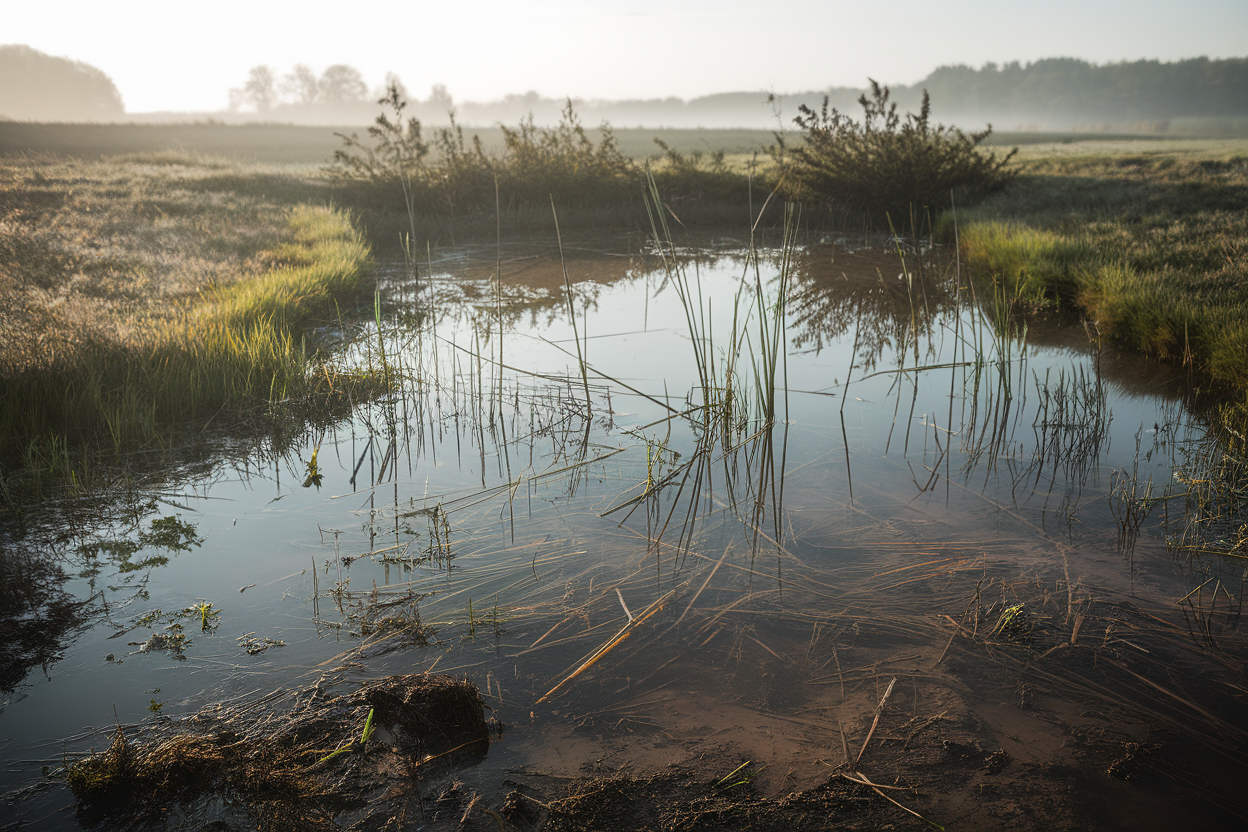
That soggy ditch behind the cornfield? The puddly low spot that never really dries out? Turns out those little nothing-burgers add up to something huge.
Researchers at the University of Texas at Austin, writing in Nature Climate Change, say tens of millions of small wetlands—too small, too scattered, too easy to miss on a map—are responsible for about 24% of global methane emissions from non-forested wetlands.
Translation: climate math that focuses on the big, famous swamps and peatlands is leaving a lot of methane on the table.
Why even a “tiny” wetland can belch methane
Methane (CH4) comes from the same basic recipe whether you’re talking about a sprawling marsh or a waterlogged depression the size of a suburban backyard: saturated soil, low oxygen, and organic gunk that microbes can chew through.
When ground stays soaked, oxygen can’t move well through the soil. Microorganisms switch to a different kind of metabolism and—boom—methane. Wikipedia’s overview of wetland methane emissions points out that the most oxygen-starved wetlands, along with some permafrost regions, rank among the biggest natural sources of atmospheric methane.
And here’s the kicker: there’s no magic “minimum size” where a wetland becomes climate-neutral. A temporary pond, a drainage ditch that stays swampy, a low spot that floods after storms—if it stays wet long enough, it can run the same methane factory as a big marsh.
The headline number: 24% from wetlands many maps barely show
The UT Austin team’s main move was scale. They zeroed in on tens of millions of small wetlands worldwide that often don’t show up well in common datasets or get shortchanged in inventories.
Put them together, and these small sites account for 24% of methane emissions from the world’s non-forested wetlands, according to the Nature Climate Change paper.
That’s not a rounding error. It means a meaningful slice of “natural” methane isn’t coming only from the big-name wetlands everyone can point to on a globe—it’s coming from a million little patches that look like messy ground.
Other public-facing summaries have been hammering the broader point for a while: wetlands dominate natural methane. One French outlet, Novethic, notes that roughly 40% of methane emissions come from natural sources, with wetlands doing a lot of the heavy lifting. Daily Science has also highlighted that among aquatic ecosystems, wetlands like marshes out-emit lakes by a wide margin.
Why these wetlands slip through the cracks
Global mapping tends to reward what’s big, continuous, and stable. Small wetlands are the opposite: fragmented, seasonal, sometimes hidden under vegetation, and easy to confuse with other land types depending on the month.
A spot can look dry in one satellite pass and turn into a sponge after a wet season. In farm country or on the edges of suburbs, you get a patchwork of ditches, depressions, river margins, and runoff zones—plenty of wet ground, not much of it officially labeled “wetland.”
There’s also a human bias at work. Big wetlands are visible, famous, often protected, and monitored. Small ones get treated like inconvenient terrain. Methane doesn’t care about your signage.
From the tropics to the deep freeze, methane isn’t evenly spread
Natural methane emissions aren’t distributed neatly across the planet. The Canadian newspaper Le Devoir has reported scientists linking rising natural methane emissions to parts of equatorial Asia and Africa—hot, wet regions where the conditions for methane production are basically on permanent “on.”
Then there’s permafrost. In colder regions, seasonal thawing and shifting soil conditions can change how much methane gets produced and released. Different places, different rhythms—but the same underlying chemistry: wet, low-oxygen ground makes methane.
The UT Austin study’s contribution is forcing attention onto the in-between spaces—the small, scattered wetlands that sit between the big blocks on land-cover maps. If you want better methane budgets, you don’t get to ignore the messy bits.
What this changes for how we talk about wetlands
Wetlands usually get sold to the public as wildlife havens, water filters, and flood buffers—and they are. But methane complicates the picture. These places can be ecological gold while also being natural greenhouse-gas sources.
The practical takeaway isn’t “drain the puddles.” It’s that governments, land managers, and researchers need better detection and classification—better inventories, better monitoring, better accounting—especially for wetlands that are small, temporary, or chopped into fragments by agriculture and development.
Because once you accept that these overlooked patches contribute 24% of methane emissions from non-forested wetlands, pretending they don’t exist stops being a harmless oversight and starts being bad climate bookkeeping.
Sources
University of Texas at Austin study in Nature Climate Change (as cited in the original French article); Wikipedia: “Émissions de méthane des zones humides”; Novethic; Maison du Lac de Grand-Lieu; Le Devoir; Daily Science.