

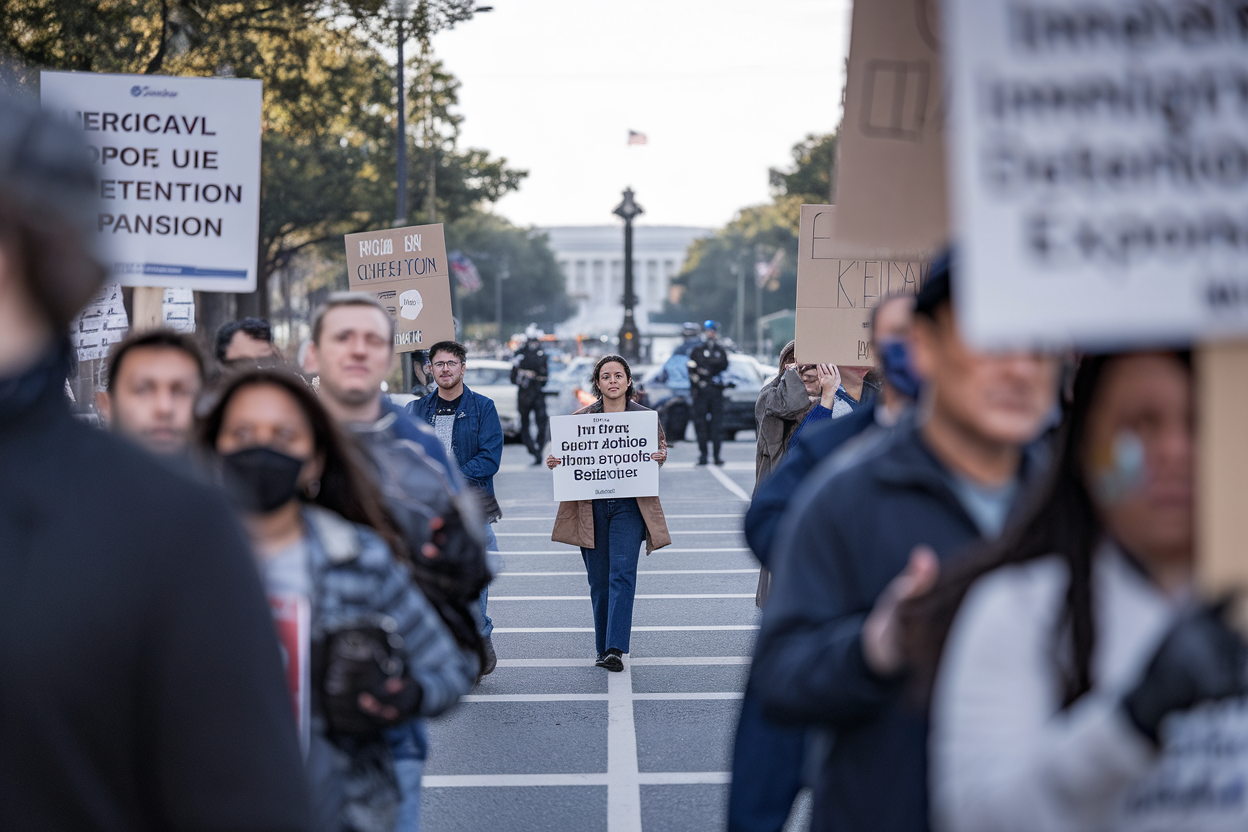
ICE wants more beds. More buildings. More places to stash migrants out of sight and out of mind.
And a growing coalition of activists is betting they can stop that expansion the old-fashioned way: by making it a local political nightmare. This Saturday, organizers behind a campaign called Disappeared in America are planning a coordinated national day of protests aimed squarely at blocking new or expanded immigration detention centers.
Their pitch is blunt: don’t just yell at Washington. Starve the projects where they actually get built—at city halls, zoning boards, permit offices, and budget hearings.
“Disappeared in America” is targeting permits, public money, and local cooperation
The movement’s demands aren’t abstract. They want local governments to refuse the nuts-and-bolts help detention sites need to exist: permits, public funding, and local resources—everything from utility hookups to service contracts.
Because here’s the part that gets lost in the cable-news shouting: even when the federal government drives immigration policy, detention facilities still depend on local decisions. Roads have to connect. Fire codes have to be signed off. Health inspections happen. Trash gets hauled. Contractors get paid. Renovations get approved. Every “routine” step is a pressure point.
Organizers are trying to turn those pressure points into veto points—by pulling in a messy, broad mix of people: immigrant-rights groups, faith leaders, lawyers, unions, neighborhood associations, and sympathetic city officials. The message isn’t fancy. It’s basically: don’t help ICE build a bigger cage.
Critics cite mold, rotten food, and abuse inside detention facilities
The moral fuel for this campaign is the long-running drumbeat of allegations about conditions inside detention centers: poor hygiene, spoiled food, mold problems, and abuse. Advocates argue things have gotten worse as immigration enforcement has hardened.
Nanci Palacios, who leads organizing and membership at the Detention Watch Network, says detention has stayed conveniently invisible for a lot of Americans. “I think that for a very long time, people have been able to look away, or maybe ignore it,” she said.
That’s the point of the protests: drag these facilities—often remote, hard to access, and wrapped in bureaucracy—into public view. And force local leaders to answer a question they’d rather dodge: why are we helping expand a system accused of treating people like inventory?
Philadelphia’s “ICE OUT” vote shows how cities are testing the legal limits
Street protests are only half the play. In some cities, elected officials are trying to shrink cooperation with federal immigration enforcement through local law.
In Philadelphia, the City Council approved a package of bills branded ICE OUT and sent it to Mayor Cherelle Parker for review. The measures would tighten rules around city cooperation with ICE—banning 287(g) agreements that deputize local law enforcement to work with ICE, limiting information sharing, requiring visible identification for agents, barring discrimination based on immigration status, and restricting ICE access to city property without a judicial warrant.
But the fine print matters—and so does the law. Charlie Ellison, executive director of the city’s Office of Immigrant Affairs, said he understands the intent but called six of the seven bills legally problematic, with city lawyers still reviewing recent amendments.
Translation: even when cities want to throw sand in the gears, they can get dragged into court, forced to rewrite, or pressured into timid enforcement to avoid expensive legal fights. Still, for national organizers, Philly is a proof of concept: opposition can be written into policy, not just chanted into a megaphone.
In Chicago’s Little Village, fear of ICE is reshaping everyday life
The fight isn’t confined to detention sites. It’s bleeding into daily community life.
Chicago’s Little Village neighborhood canceled its Cinco de Mayo parade for the second year in a row. Community leaders said they were surprised—some believed ICE activity hadn’t been as intense this year.
That’s the ugly reality: even when raids aren’t visibly spiking, the fear can do the job all by itself. People skip public events. Businesses lose foot traffic. Churches and schools adjust plans. Neighborhood life gets quieter—not because everyone suddenly got boring, but because the risk calculation changed.
Organizers are trying to connect those dots: the locked-down facilities on the outskirts and the self-censorship in the neighborhoods. If they can make Americans see detention expansion as something that reaches into local economies and culture—not just “an immigration issue”—they think they can build a bigger coalition.
Immigration politics, labor needs, and the push to normalize mass detention
The detention-center expansion fight sits inside a larger brawl over immigration—and over the economy. Whole industries rely on immigrant labor, documented and undocumented. At the same time, hardline politics sells the promise of control: more enforcement, more capacity, more “consequences.”
To supporters of tougher enforcement, expanding detention looks like follow-through. To opponents, it looks like the government deciding that confinement is the default tool—and then building the infrastructure to make it permanent.
Organizers say they’re trying to harness the energy of recent protests, including the No Kings demonstrations, and aim it at something that usually escapes public attention because it’s technical and tucked away behind contracts and permitting.
They’re also picking a target that’s politically flammable. Detention centers are hard to defend when the public associates them with mold, medical neglect, and mistreatment. Officials tend to respond with management-speak—security, capacity, compliance. Activists are trying to keep the argument grounded in bodies and consequences, and to make local officials feel the heat for enabling expansion.
The real test comes after Saturday. Can protesters keep pressure on through the slow grind of local approvals? And will federal officials and private contractors speed up projects, shift locations, or rebrand to lower the political temperature?
For the people trying to block expansion, the goal is simple: make every new detention project an immediate political cost for the local leaders who help it happen.