

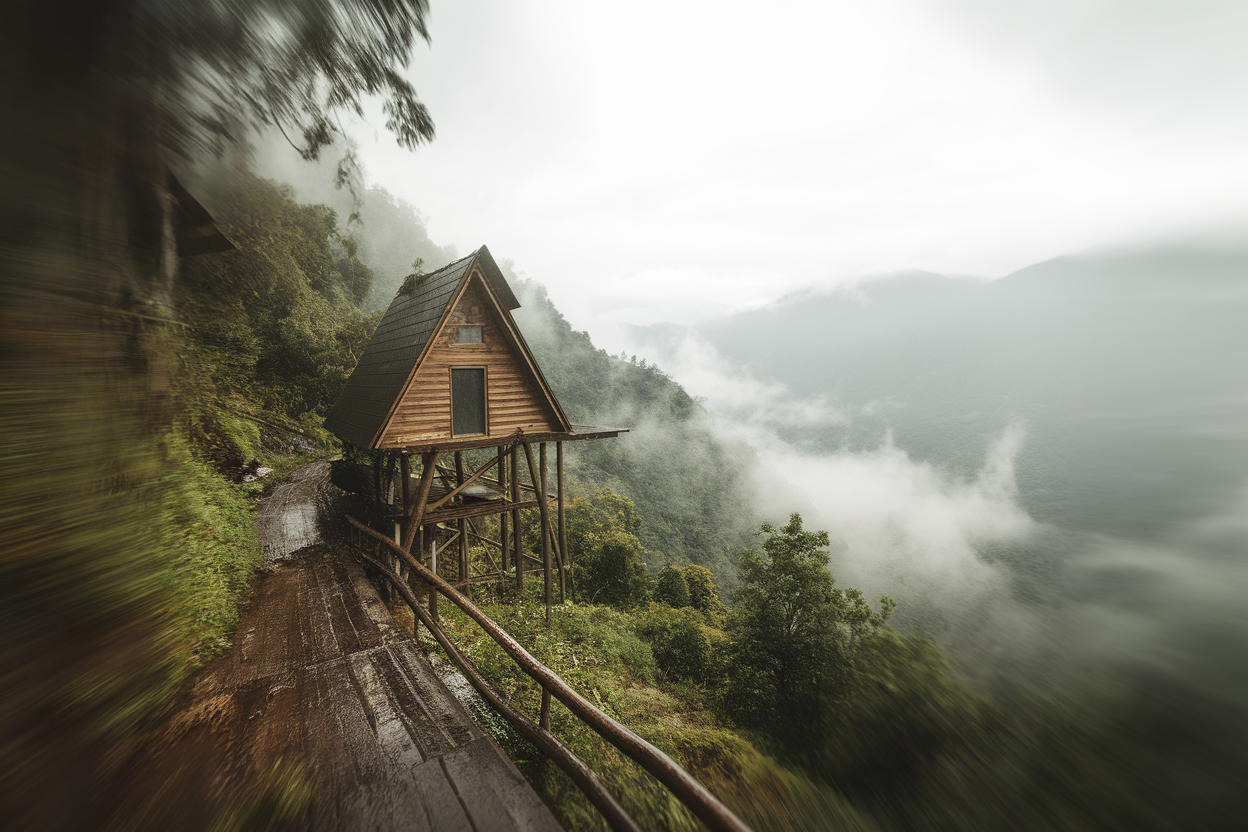
The air up above Mindo doesn’t just feel damp—it clings. Fog grabs the leaves, light breaks into shards, and the mountains play hide-and-seek behind low clouds like they’ve got better things to do than pose for your vacation photos.
And then you spot it: a small wooden cabin, lifted off a steep hillside, sitting there like it’s trying not to get in anyone’s way. Because it is.
It’s called Casa 6-3, built by Baquio Arquitectura, and it’s basically a micro-hideout designed for one job: give you a front-row seat to Ecuador’s cloud forest without bulldozing the place to make room for your “nature escape.”
A cabin that treats the hillside like a fact, not a problem
Casa 6-3 starts with two constraints that most developers love to “solve” with heavy machinery: a serious slope and a sensitive ecosystem. The cabin sits on the upper reaches of Mindo, in Ecuador’s Chocó region—an area known for wet, steep terrain and the kind of biodiversity that makes scientists sound like kids in a candy store.
Instead of carving out a flat pad (the usual move), Baquio Arquitectura went elevated. The structure perches above the ground, minimizing digging and letting the hillside stay a hillside. It reads less like a “house” and more like a shelter—small, deliberate, and pointed outward toward the view.
The whole concept is restraint: a tiny timber retreat that’s there to look, not to sprawl. You’re not meant to forget where you are. You’re meant to feel suspended between canopy and horizon.
Wood, lifted off the ground, because cloud forests don’t play nice
Calling it a wooden cabin sounds almost too obvious—until you remember where it is. In a cloud forest, moisture isn’t weather; it’s the default setting. Getting the structure up off the ground isn’t some cute design flourish. It’s comfort, durability, and basic respect for a soggy environment rolled into one.
The project gets described as a “compact elevated shelter,” which is architecture-speak for: small footprint, minimal fuss, and no pretending the terrain should behave like a suburban lot.
And that’s the point. This is part of a broader trend in Ecuador (and everywhere else, frankly): micro-architecture that tries to slip into a place instead of conquering it. Less square footage, more experience. The landscape does the heavy lifting.
The Chocó: a rainforest so rich it’s basically a living lab
Americans might not recognize the name “Chocó,” but the region has a reputation that carries weight in conservation circles. Mashpi Lodge—one of the better-known eco-luxury operations in Ecuador’s Andean Chocó—calls it a biodiversity hotspot with high endemism, meaning plenty of species live here and nowhere else. Their pitch is blunt: this is a “living laboratory,” and scientists are still figuring out what all is out there.
That’s also why architecture here can’t just be Instagram bait. It becomes an interface between visitors and a dense, complicated ecosystem. The cloud forest messes with your sense of time: views open and vanish, light changes fast, mist rolls in like a curtain drop.
A perched cabin aimed at the mountains fits that drama. You’re not controlling the scenery. You’re watching it happen.
Tiny cabins are booming—and that’s both cool and a little worrying
Yes, tiny stays are hot. Airbnb has an entire page pushing tiny-house rentals in Ecuador, and travelers rave about the usual stuff—location, cleanliness, the vibe of being “in nature” without actually sleeping in mud.
In a place like Mindo, the appeal is obvious: hike up, settle into a small shelter, listen to rain hammer the roof, watch fog pour through the trees. The cabin becomes a framing device, turning weather and topography into the main event.
But let’s not kid ourselves: when these things multiply, fragile places can turn into products fast. The best versions keep the building small and the site intact. The worst versions are just eco-aesthetics stapled onto development.
Casa 6-3, at least as it’s presented, lands on the better side of that line—compact, elevated, and trying hard to leave the forest as the star. It’s a little wooden box on a steep slope, offering the simplest trade imaginable: less inside, more outside.