

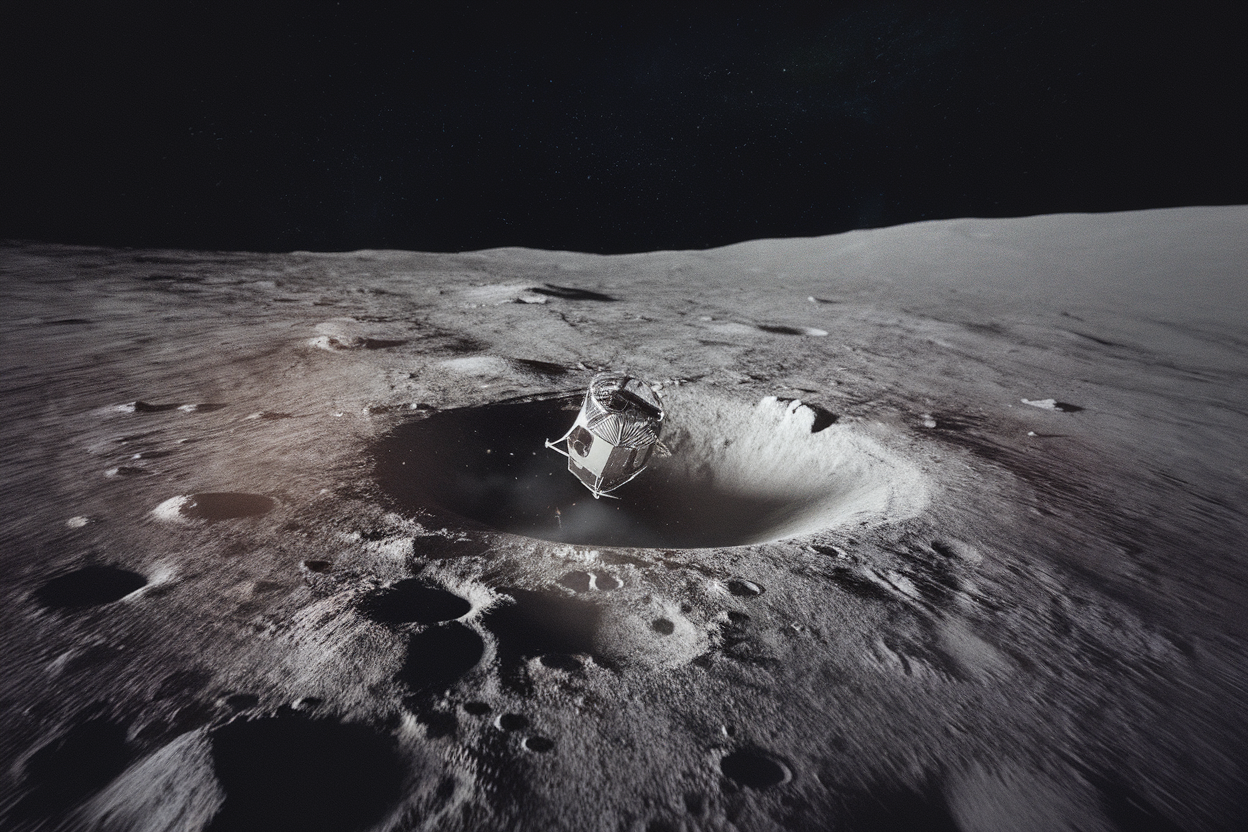
SpaceX is about to “land” on the Moon again—except this time it’s not a lander, it’s junk.
According to a new report circulating among space trackers, an out-of-control upper stage from a Falcon 9 rocket is expected to slam into the Moon this summer, potentially punching out a fresh crater. Nobody’s in danger. The Moon doesn’t have pedestrians. But the episode is a flashing warning light about how casually we’re letting hardware drift around cislunar space like it’s an infinite parking lot.
Astronomer Bill Gray pins the impact to Aug. 5 near the Einstein crater
The prediction comes from astronomer Bill Gray, the guy behind “Project Pluto,” software widely used to track near-Earth objects. His report hasn’t been peer-reviewed, but it’s not hand-waving. Gray says he’s highly confident the impact will happen at 2:44 a.m. EDT on Aug. 5, near the Moon’s Einstein crater—on the side of the Moon we can see from Earth.
His logic is old-school orbital mechanics: once a dead object is coasting, its path is dominated by gravity—Earth, the Moon, the Sun, and even the planets. Those gravitational parameters are known extremely well. The real question isn’t whether the thing keeps wandering. It’s when the wandering ends with a faceplant into lunar dirt.
Gray also admits the limits: you’re not going to get “down to a few meters and fractions of a second” precision, because tiny forces can nudge the trajectory over time.
The culprit: a 45-foot upper stage from a Jan. 15, 2025 launch
The object in question is described as a 45-foot-long Falcon 9 upper stage left behind after a Jan. 15, 2025 launch that carried two lunar landers: Firefly Aerospace’s Blue Ghost and ispace’s Hakuto-R.
After doing its job, the stage wasn’t recovered and kept looping around Earth on an orbit broadly similar to the Moon’s. Gray says asteroid-observation programs have spotted it more than 1,000 times over the past year—an absurd number that also makes the tracking pretty solid. Lots of sightings plus a stable orbit equals a confident forecast.
There’s a darkly funny twist here: telescopes built to protect us from natural space rocks are now spending their time cataloging our own leftovers. From a math standpoint, a dead rocket stage becomes just another object obeying physics. From a responsibility standpoint, it’s a different story.
Gravity is predictable; sunlight is the troublemaker
Gray’s report boils the uncertainty down to one pesky factor: solar radiation pressure—sunlight literally pushing on the object. It’s a small force, but over long periods it matters, especially when the debris is tumbling and constantly changing which surfaces are catching and reflecting light.
The push is generally away from the Sun, with a small sideways component depending on the object’s shape and orientation. That’s enough to fuzz up the “exactly where, exactly when” details—without changing the big headline that the Moon is going to get hit.
Expected speed: 1.51 miles per second—fast enough to make a crater
Gray estimates the stage will hit at about 1.51 miles per second—roughly seven times the speed of sound on Earth. At that speed, you’re not talking about a gentle scatter of metal. You’re talking about an impact that could plausibly carve out a new crater.
Scientifically, an artificial impact isn’t worthless. It can teach researchers something about how energy propagates through the Moon’s dusty regolith and what the ejecta pattern looks like. But the bigger point is uglier: this is what happens when you treat “end of mission” like “not my problem.”
The Moon used to feel like an empty desert where random collisions were basically a rounding error. That era is ending. More missions, more hardware, more stuff left behind—eventually the odds catch up.
The 2022 reminder: the “double crater” surprise
Gray has been here before. In 2022, he correctly predicted another abandoned rocket piece would smack into the Moon. Early on, some researchers thought that one was also a Falcon 9 stage. Later, it was identified as debris from China’s Chang’e 5-T1 lunar mission.
That impact produced a weird result: a double crater. Scientists were still working through why—structure of the object, angle of impact, local terrain, take your pick. The lesson is simple: even when you know a collision is coming, you can still get surprised by what it does.
More debris, more lunar traffic—and less room for sloppy habits
Gray’s broader warning isn’t really about one SpaceX stage. It’s about the growing pileup of debris in Earth orbit and beyond, and how “uncontrolled” trajectories can wander for a long time before they wander into something that matters.
And plenty is about to matter. The U.S. and China are both ramping up lunar ambitions—landers, orbiters, and eventually infrastructure. In that kind of environment, abandoned hardware stops being a cleanliness issue and starts looking like a planning failure. A dead stage can drift harmlessly for months or years, then show up in the wrong neighborhood at the wrong time—like a beer bottle tossed off a balcony that doesn’t hit anyone… until it does.
Gray’s bottom line: this particular impact won’t hurt anybody. But it’s a pretty clean example of negligence baked into the system—missions designed without a credible end-of-life plan for the stuff that doesn’t come home and doesn’t get deliberately deorbited.