

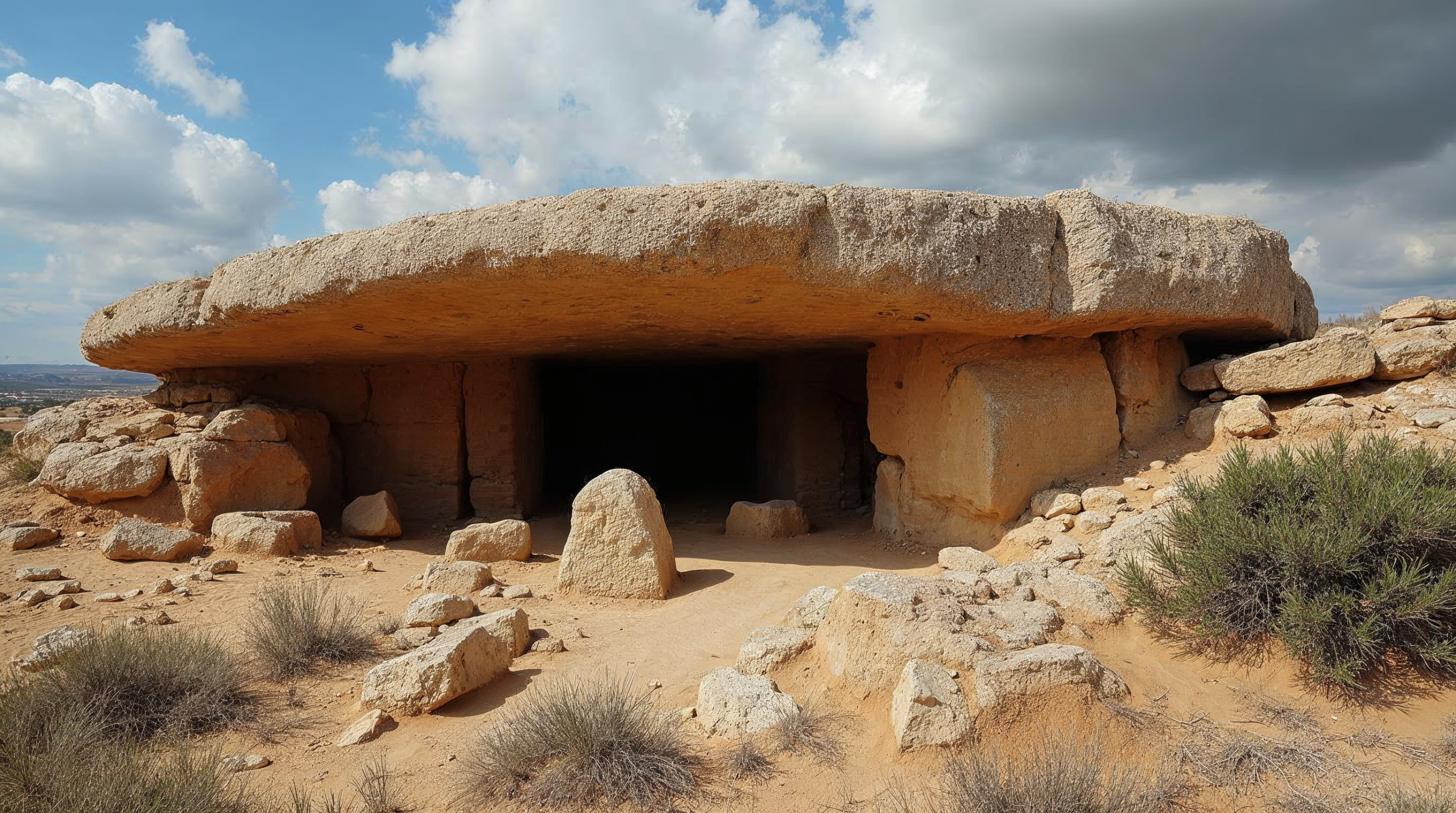
Two medieval guys got buried at the front door of a Stone Age mega-tomb in southern Spain. And thanks to ancient DNA, they’re now telling a story that doesn’t fit the neat little boxes people love.
The place is the Dolmen of Menga, a hulking megalithic tomb built more than 5,000 years ago near Antequera, in Andalusia. Archaeologists expected prehistory. Instead, they found Middle Ages—two adult men laid into simple graves right at the entrance. No fancy goods. No treasure. Just bodies, placed with intention.
Then the genetics came back with a kicker: one of the men carried a mix of ancestry tied to Europe, North Africa, and the eastern Mediterranean—especially the Levant. In other words, this wasn’t some sealed-off “local” story. This was the medieval Mediterranean doing what it always did: mixing people, cultures, and bloodlines, whether modern nationalists like it or not.
A Stone Age monument that still dominated the medieval landscape
Menga isn’t a cute little pile of rocks. It’s a serious piece of engineering: a corridor tomb about 82 feet long and roughly 20 feet wide, built from massive upright stones (orthostats) and roof slabs.
Some of those stones are estimated around 165 tons. That’s not “a few villagers with spare time.” That’s a society with organization, muscle, and a reason to build something meant to last.
The dolmen sits in the UNESCO-listed Antequera megalithic landscape—one of those places where the monument and the surrounding terrain are basically part of the same message. Americans who haven’t heard of Antequera can think of it like this: it’s a protected cultural zone where ancient structures still shape how the land is read and used.
And that’s the point. Even after the people who built Menga were long gone, the thing stayed put—looming, memorable, and available for later communities to reuse, reinterpret, or quietly exploit.
The 2005 dig: two medieval burials where they “shouldn’t” be
In 2005, archaeologists excavating the entrance area uncovered two adult male burials. Their placement made it obvious they came long after the dolmen’s construction.
Radiocarbon dating pinned the better-preserved individual to roughly the 10th–11th centuries AD. The second man dated more broadly, somewhere between the 8th and 11th centuries.
They were buried in simple pits, and the reporting doesn’t mention grave goods. But the bodies weren’t tossed in randomly. They were aligned with the dolmen’s axis—heads turned toward the southwest, faces toward the southeast.
That orientation has been read as possibly aiming the dead toward Mecca, though it doesn’t line up perfectly with standard Islamic burial practice. And that mismatch matters: medieval life around the Mediterranean was messy. Rituals travel. People adapt. And when you’re burying someone at the entrance of a prehistoric stone corridor, the architecture itself can force compromises.
Ancient DNA in hot-country conditions: degraded, scarce, but not useless
Ancient DNA is a fragile business, and warm Mediterranean environments are notoriously rough on preservation. The study (hosted on ScienceDirect) describes the DNA content at Menga as extremely low and heavily degraded—exactly the kind of sample that makes geneticists grind their teeth.
So the researchers used a targeted method called SNP enrichment, basically a way to fish out informative genetic markers even when the sample is damaged.
It worked—sort of. One individual, labeled Menga1, yielded a genome-wide profile good enough for real analysis. The other man didn’t preserve well enough to get the same resolution.
This is the part people misunderstand about archaeogenetics: it doesn’t hand you a passport stamp history. It gives you signals—ancestry components built up through generations of movement, marriage, conquest, trade, slavery, conversion, and plain old proximity.
Menga1’s ancestry: Europe, North Africa, and the Levant in one medieval skeleton
The headline result is Menga1. His genetic profile combines uniparental lineages described as typical of European populations, plus genome-wide contributions linked to North Africa and the Levant.
That mix doesn’t mean he personally hopped a boat from Beirut to Málaga. It means his family tree—over time—picked up branches from multiple sides of the Mediterranean. Which tracks with what historians already know: medieval Iberia wasn’t some isolated Christian fortress or a monolithic “Muslim Spain” caricature. It was a contact zone, constantly reshaped by migration, intermarriage, and shifting power.
And there’s a delicious irony here. The entrance of a Stone Age tomb—built for a prehistoric community—turns into a medieval burial spot for a man whose DNA reflects a far wider world than the builders of Menga could’ve imagined.
Why bury medieval dead at the mouth of a prehistoric tomb?
Genetics can tell you ancestry. It can’t tell you motive. The bigger human question is why these men ended up at Menga’s entrance at all.
The simplest answer is also the most plausible: the place still meant something. A dolmen like Menga is an obvious landmark—ancient, imposing, already associated with death. That kind of site attracts stories, taboos, reverence, opportunism, or all of the above.
The careful alignment of the bodies with the monument’s axis suggests this wasn’t casual. Whoever buried them was “talking” to the architecture—using the corridor, the directionality, the sense of passage. Medieval people didn’t need to know the dolmen’s original meaning to recognize its power.
A UNESCO site, a warming climate, and the race to document what survives
The Menga story doesn’t end with a cool ancestry chart. It’s also a reminder that heritage sites aren’t single-era museum pieces. They’re layered. A place can be a prehistoric tomb, then a medieval burial ground, then a modern tourist stop with a UNESCO plaque.
The article also nods—quietly but clearly—to a modern problem: preservation is getting harder. If DNA is already difficult to recover in Mediterranean conditions, rising heat and environmental stress won’t help. That makes today’s documentation—excavation, radiocarbon dating, genetic sampling—feel less like academic indulgence and more like triage.
Menga has been standing for 5,000-plus years. And it’s still coughing up new evidence. Two modest medieval burials, stuck at the threshold of a Stone Age monument, just widened the story of who moved through Iberia—and how deep the Mediterranean’s human entanglements really run.