

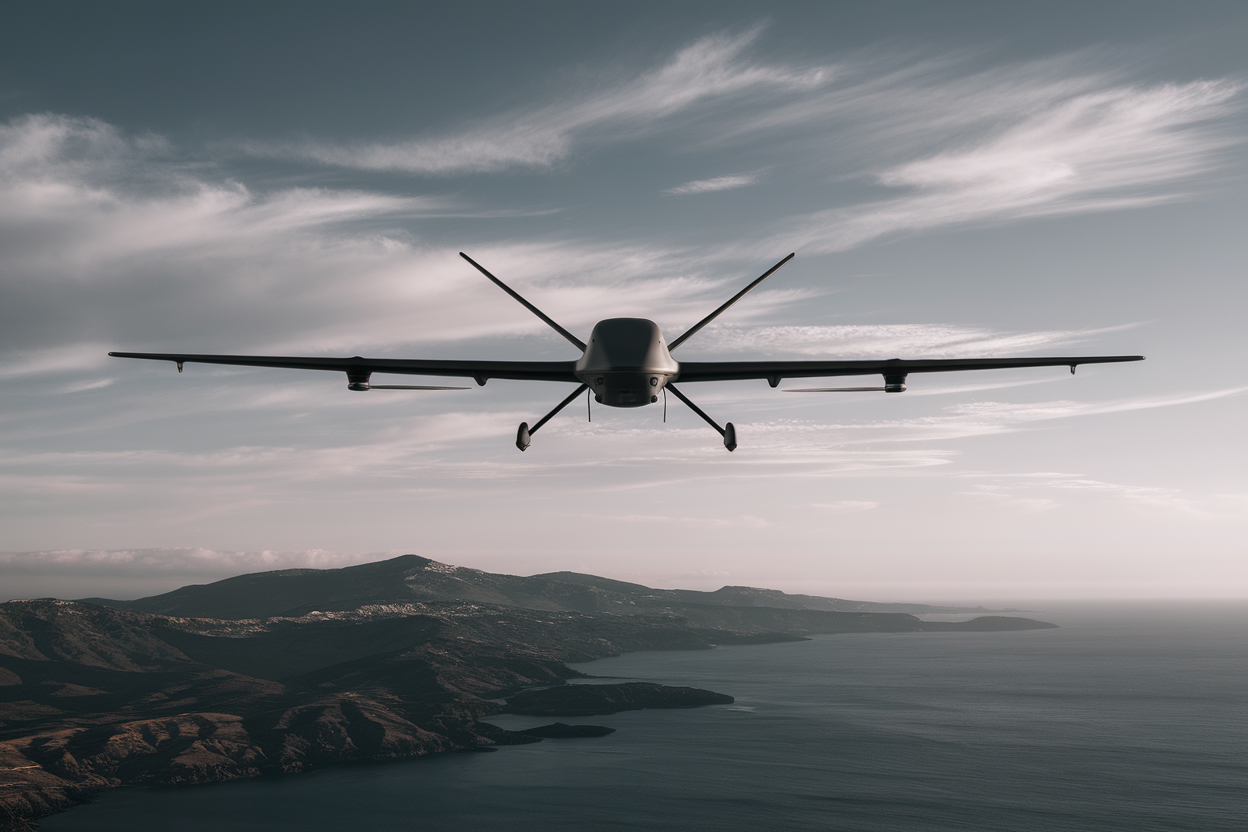
A weird, batwing-shaped aircraft may have cruised over Greece in recent days—and the internet’s defense nerds immediately slapped a familiar label on it: the RQ-180, America’s rumored, never-properly-acknowledged stealth spy drone.
If they’re right, it would be one of the clearest public sightings yet of a platform the U.S. government treats like a family secret. And the timing isn’t random. Greece sits at the crossroads of the Black Sea, the Balkans, the eastern Mediterranean, and the Middle East—exactly the kind of neighborhood where Washington likes to know what everyone’s doing, preferably without being noticed.
A viral silhouette, a lot of confidence, and not much proof
The whole thing starts with short video clips and screenshots said to be filmed from Greece. The object looks like a flying wing—no tail, no obvious fuselage—gliding along like it owns the sky. That shape is catnip for anyone tracking classified U.S. aviation programs.
But here’s the problem: the evidence is the kind that fuels arguments, not the kind that closes them. No verifiable metadata. No clean geolocation. No timestamp you can independently lock down. And because classified aircraft don’t show up on civilian flight-tracking sites—and military flights can simply go dark—there’s no easy way to cross-check the sighting against public air-traffic data.
Imaging specialists also point out the obvious: “flying wing” doesn’t automatically mean “RQ-180.” At a distance, with compression artifacts and a lousy angle, a bunch of aircraft can look like a spooky triangle. The more secret the program, the more people want to pin every mystery speck in the sky on it.
Neither the Greek military nor the Pentagon has said a word. That’s standard operating procedure for sensitive programs. It’s also a great way to let speculation do the messaging for you—free of charge.
Why Greece is a handy perch for U.S. eyes in the sky
Pull up a map and Greece practically explains itself. From Greek territory, an intelligence platform can keep tabs on routes stretching from the Adriatic toward the Black Sea, and from the Levant down toward North Africa. For U.S. planners, that’s a lot of coverage from one friendly NATO member with usable infrastructure.
The eastern Mediterranean is a crowded pool: Greece and Turkey sniping at each other, energy politics, undersea cables, Russian naval activity, and the spillover from conflicts in the Middle East. Add the Ukraine war and the Black Sea’s constant churn, and you’ve got plenty of reasons to run long-range surveillance missions nearby—even if you never cross into anyone’s airspace.
Greece isn’t on the Black Sea, but it doesn’t need to be. Intelligence missions care about ship movements, radar behavior, communications traffic, and patterns—stuff you can often collect from international corridors if your sensors are good enough and your platform can loiter.
There’s also the politics: Athens has been tightening its relationship with Washington for years. Hosting more U.S. activity—quietly or otherwise—can boost Greece’s standing and interoperability. It can also make Greece a bigger target for regional complaints that it’s helping the U.S. keep tabs on the neighbors.
What the RQ-180 is supposed to be—and why secrecy is part of the weapon
Public information on the RQ-180 is scraps and whispers. Analysts generally describe it as a long-endurance intelligence, surveillance, and reconnaissance (ISR) drone designed to operate around modern air defenses—basically, a move away from the era when U.S. drones could fly around uncontested.
Stealth isn’t magic. It’s engineering trade-offs: shapes, materials, and payload constraints in exchange for a smaller radar signature and a harder intercept problem. And no, stealth doesn’t mean invisible to the naked eye. It means tougher to detect and track with radar and certain sensors—so a visual sighting isn’t automatically nonsense.
The deeper point is that secrecy itself does work. If rivals can’t confidently gauge what a platform can see, how far it can reach, or how often it’s overhead, they have to assume the worst. That uncertainty can be deterrence—without a press release.
The downside is democratic oversight. Classified programs get funded, but the public debate over costs, risks, and rules of engagement is thin by design. You can’t argue about what you’re not allowed to know.
Deterrence, miscalculation, and the risk of somebody getting jumpy
If a stealth ISR drone really did show up near Greece, the message to regional players is simple: you’re being watched. In geopolitics, surveillance is power. It shrinks the room for surprise and can discourage certain moves if leaders believe they’ll be spotted early.
But surveillance flights also carry a familiar risk: the closer you operate to sensitive areas, the more likely you get an “incident”—an aggressive intercept, electronic jamming, a misread maneuver. And when the aircraft is classified, the other side may assume it’s doing something more threatening than it actually is.
For Greece, that’s the tightrope. U.S. and NATO cooperation can mean more security and better intelligence. It can also feed the narrative that Athens is a forward observation post, which plays badly in a region where air and sea run-ins already happen.
Right now, the only honest verdict is this: the footage is intriguing, not conclusive. Still, the frenzy around it tells you something real. In the eastern Mediterranean, even a blurry shape in the sky can land like a signal flare.
What we can say for sure—and what we can’t
We can say people are circulating imagery from Greece that appears to show a flying-wing aircraft. We can say the RQ-180 is a widely discussed (and widely unconfirmed) candidate for that silhouette. We can say Greece is strategically positioned for U.S. surveillance missions tied to the Black Sea, the Levant, and the broader eastern Mediterranean.
We can’t independently verify the aircraft’s identity from the available material. And until someone produces hard, checkable details—or an official source decides to stop playing coy—this stays in the category of “plausible, interesting, unproven.”