

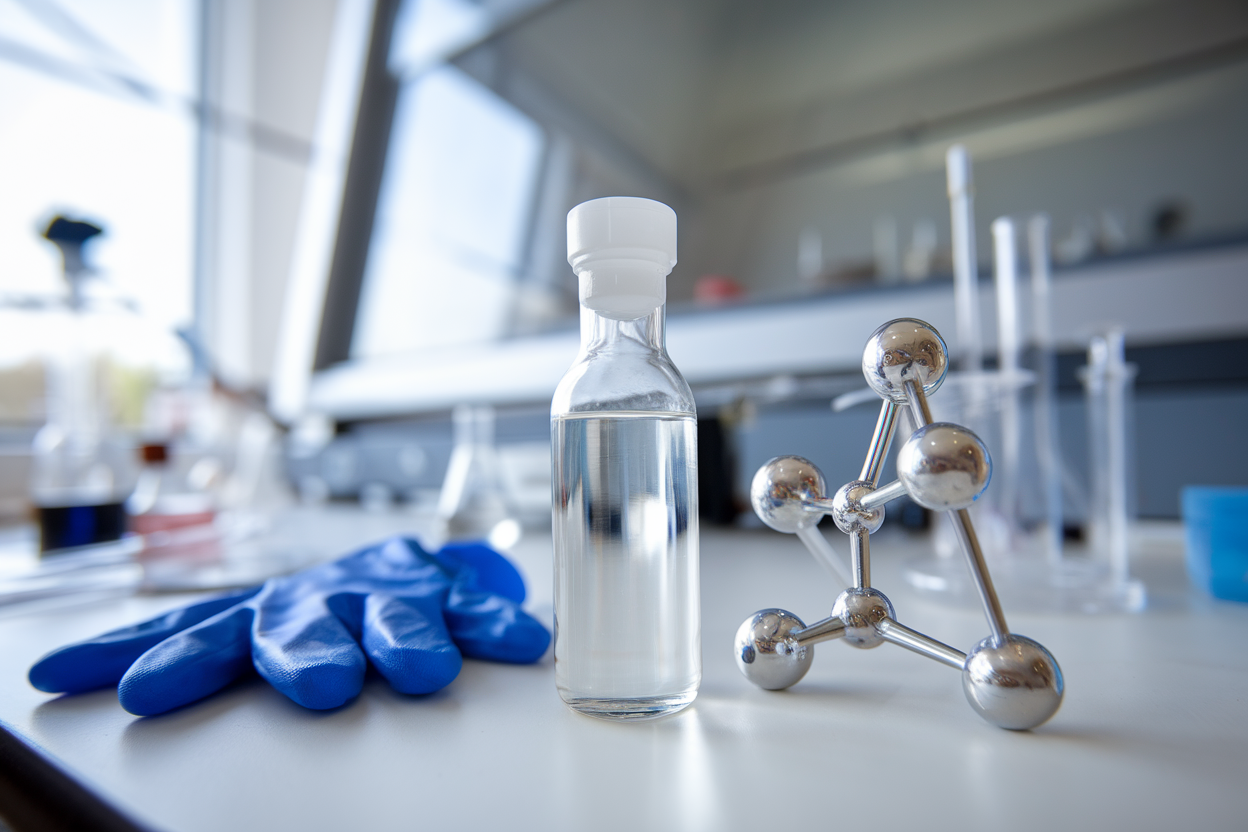
Picture three aluminum atoms holding hands in a neat little triangle—and refusing to let go even when you dunk them in solution. That’s the headline out of a new paper from King’s College London, and it’s the kind of nerdy chemistry that can turn into real-world leverage when supply chains get ugly.
The work, published in Nature Communications, is basic research. No one’s bolting this onto a refinery tomorrow. But the subtext is loud: if chemists can coax cheap, abundant aluminum into doing jobs usually reserved for pricey “critical” metals like palladium and platinum, the chemical industry gets a new escape hatch.
The weird part: aluminum in a low oxidation state that actually sticks together
Most industrial aluminum chemistry lives in the safe, familiar world of aluminum(III)—Al(III)—the buttoned-up version of the element. What King’s College is reporting is a neutral trimer of aluminum(I), Al(I), arranged as a three-membered ring: a cyclotrialumane. Translation: a tiny aluminum triangle.
That might sound like a cute structural detail. It isn’t. Chemists have been chasing neutral, trimeric Al(I) species for a long time because they’re notoriously hard to isolate. The literature has basically treated them as missing in action or too unstable to matter.
This team says they’ve got two examples—and here’s the kicker: the trimer doesn’t just show up in the solid state for a pretty crystal structure. It stays intact in solution, where chemistry actually happens and where catalysts have to live if they’re going to earn their keep.
Stable doesn’t mean tame—and that’s the whole point
Keeping a reactive species alive in solution is like keeping a tiger calm in a phone booth. The researchers describe reactivity that can go after bonds chemists usually treat as “tough.” That’s the kind of claim that makes synthetic chemists sit up, because bond activation is where the money is—literally, in pharmaceuticals, materials, and specialty chemicals.
The implied pitch is straightforward: maybe you can do certain hard transformations without leaning so heavily on transition metals. And maybe you can do them in ways that aren’t just a bargain-bin imitation of palladium, platinum, or rhodium chemistry.
Why everyone’s suddenly allergic to platinum-group metals
Catalysts are the chemical economy’s invisible plumbing. They speed reactions, cut waste, improve selectivity, and save energy—exactly the stuff that determines whether a process is profitable or a dumpster fire.
The problem: many of the best catalysts rely on platinum-group metals—platinum, palladium, rhodium, iridium. They work great. They also come with volatile pricing, concentrated supply, and the kind of geopolitical and environmental baggage that makes procurement teams sweat.
In comments relayed by King’s College London, chemist Adrian Bakewell calls transition metals the “workhorses” of synthesis and catalysis—while acknowledging they’re getting harder to access and extract. No kidding. If your process depends on a metal with a fragile supply chain, you don’t have a process. You have a vulnerability.
Aluminum, by contrast, is everywhere. The industrial base already exists. The argument here is less romantic science and more cold strategy: if low-oxidation-state aluminum chemistry can replace precious-metal systems in even a slice of applications, that’s a hedge against supply shocks.
Breaking “hard” bonds: why synthetic chemists care
King’s College’s write-up says these compounds can “break apart tough chemical bonds” and reveal molecular structures “never been observed before.” In chemist-speak, that’s a signal that the aluminum(I) triangle can activate stubborn bonds and open routes that standard playbooks don’t reach.
Think about what palladium did for carbon–carbon bond formation in fine chemicals. It didn’t solve every problem, but it became a default tool because it was reliable and broadly useful. Aluminum won’t be palladium—its electronic behavior is different—but that’s exactly why it’s interesting. Different electronics can mean different selectivity, and selectivity is the kingmaker in manufacturing: it drives yield, purity, separation costs, and waste.
There’s also a less glamorous angle: ultra-reactive compounds can be divas. If this chemistry demands pristine conditions forever—no moisture, no oxygen, no real-world mess—it’ll stay trapped in the glovebox and out of the plant.
This is also a supply-chain story, whether chemists admit it or not
The paper isn’t about rare earths or EV batteries. But it sits in the same broader scramble: industries trying to reduce dependence on materials that are geographically concentrated, politically sensitive, or both.
Since the pandemic—and then the trade fights that followed—companies have relearned an old lesson: a process that looks brilliant on paper can become a liability if one key input turns scarce or wildly expensive.
Aluminum has its own issues. Producing it is energy-hungry. But supply is structurally more diversified than platinum-group metals, and aluminum already underpins huge chunks of the economy—cars, planes, packaging, construction. The question isn’t whether aluminum can be produced at scale. It’s whether some of the catalytic value currently locked up in rare metals can be shifted onto an abundant element through smarter chemistry.
From a cool molecule to a real catalyst: the brutal checklist
Right now, this is a proof of concept with serious attitude. Industry will want answers that basic research papers don’t always deliver.
First: robustness. A useful catalyst has to run for hundreds or thousands of hours without falling apart or contaminating product streams.
Second: selectivity under dirty conditions. Lab reactions use carefully chosen substrates and controlled setups. Plants deal with trace water, oxygen, salts, and byproducts. Aluminum(I) being highly reactive is a feature—until it becomes a bug and starts side reactions or decomposes.
Third: can it actually cycle? There’s a big difference between a flashy stoichiometric reaction and a catalytic cycle that regenerates the active species efficiently. That’s where economics live.
Fourth: safety and handling. Low-oxidation-state compounds can be air- or moisture-sensitive. If this chemistry can’t leave the glovebox, it won’t matter how clever it is. The winners are the systems operators can run reliably in existing equipment.
If those hurdles get cleared, the payoff is obvious: more accessible catalysis built on an abundant element, less dependence on fragile supplies of precious metals, and potentially cheaper routes to fine chemicals. For now, King’s College London has delivered something simpler but still meaningful: a reminder that aluminum—under the right conditions—can act like a serious player in high-end chemistry, not just a structural metal you turn into cans and airplane parts.