

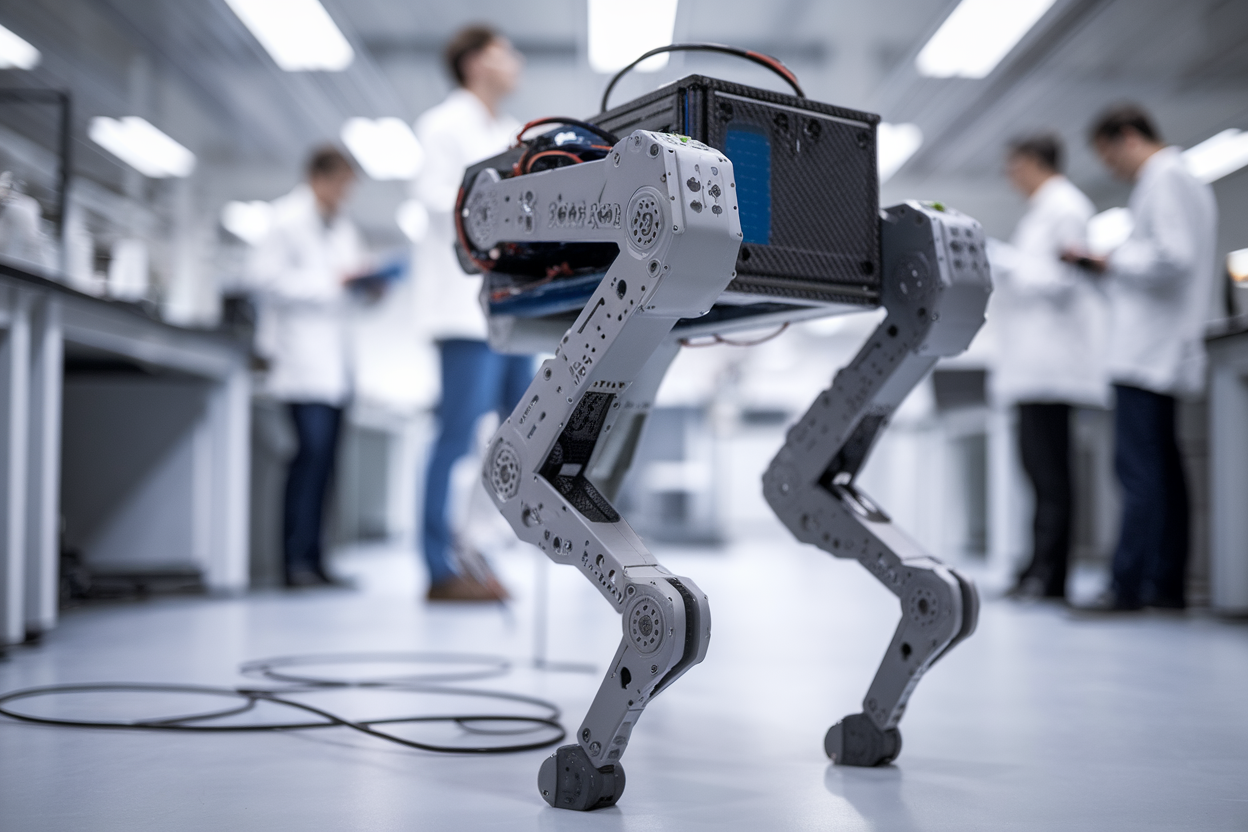
A modular robot designed with help from AI can keep walking even after it loses a leg, researchers say. That sounds like a party trick—until you remember what happens to most robots the moment something breaks: they turn into expensive, awkward paperweights.
The team’s pitch is simple: build a robot like a kit, prove it can take damage, and you’ve got a machine that’s a lot more useful outside the lab. Because out in the real world—industrial sites, tunnels, disaster zones—stuff fails. Motors seize. Joints snap. A module gets ripped off. And the mission doesn’t pause so you can reboot and pray.
The catch: the researchers haven’t released many specifics publicly—no clear institution, no dataset, no hard performance metrics. But the core idea is clear enough to matter: AI wasn’t just used to “drive” the robot. It was used to help design the robot’s body and the rules for how its parts fit together, so damage hurts less.
A robot “in a box,” built to survive a bad day
Think of the machine as a set of functional bricks: locomotion modules, joints, supports—pieces you can swap, rearrange, or replace. Industry loves modularity for boring reasons like maintenance and mission flexibility. Here, modularity is also a survival strategy.
Because losing a leg isn’t like losing a hubcap. On a multi-legged robot, every limb is part of a delicate math problem: force distribution, torque, balance, gait timing. Remove one leg and the geometry changes instantly. Without adaptation, the robot tips, slips, or cooks the remaining motors trying to compensate.
So the real technical challenge isn’t “interchangeable parts.” It’s “interchangeable parts that can still function when the system is suddenly lopsided.” That requires mechanical design that doesn’t collapse under stress—and control software that can recognize what’s still attached and adjust how it walks.
Why AI is being used to design the body, not just the brain
Most people hear “AI + robotics” and picture cameras, lidar, object recognition, maybe some fancy path planning. This project is pushing AI upstream—into the design phase.
That matters because robot design is a nasty trade-off. Make it tougher and you usually make it heavier, pricier, and more power-hungry. Make it light and fast and it gets fragile. The researchers say AI helped generate the modular design principle—potentially exploring combinations and geometries a human engineer wouldn’t try, especially when you’re aiming for fault tolerance.
And yes, they say they tested it physically in the lab, not just in simulation. That’s a big deal in robotics, where “works in simulation” is often code for “falls over the second it touches real flooring.” Real hardware introduces slop in joints, friction you didn’t model, vibrations, delays—death by a thousand tiny realities.
Walking after losing a leg: impressive demo, incomplete story
A robot that keeps moving after losing a leg is showing a real kind of robustness. In the field, that’s a common failure mode: a jammed actuator, a damaged joint, a module torn off, a critical sensor dying and taking a limb out of commission.
But a single demo doesn’t tell you what you actually need to know. What surface was it on—smooth lab floor, rough concrete, gravel, a slope? How long did it walk—ten feet or two hours? Did it succeed ten times in a row or once after twenty tries? And what did the remaining motors endure—higher loads, overheating, accelerated wear?
“It can still walk” might mean “it can crawl forward slowly in a straight line.” Useful mobility in the real world means turning, recovering from slips, stepping over obstacles, maybe carrying payloads. Without numbers—speed, power draw, endurance, repeatability—you can’t stack it up against existing platforms.
There’s also a huge difference between (1) a controlled test where the robot “loses” a leg in a clean, preplanned way and (2) a sudden failure mid-stride. The second scenario is where machines earn their keep. The public description doesn’t say which one this was.
Where this could matter: inspection, disaster response, and the harsh economics of downtime
If this approach holds up, the most obvious win is infrastructure inspection—tight spaces, hazardous sites, places where retrieving a stuck robot is expensive or dangerous. A machine that can limp home instead of dying in a pipe is a machine you can justify buying.
Logistics is trickier. Warehouses already run on fleets of wheeled robots because wheels are efficient, cheap, and reliable. A legged modular robot has to earn its higher complexity by doing what wheels can’t: handling uneven floors, debris, mixed environments, stairs, or ad-hoc obstacles. Fault tolerance could help the business case if it reduces the need for immediate human intervention.
Disaster response is the dream scenario people love to talk about—and the one that punishes weak designs. Dust, water, unstable rubble, lousy communications, human safety requirements. Modularity can make repairs faster, sure. It can also create new failure points at every connector unless those interfaces are ruggedized.
And then there’s cost. Modular systems only scale if parts are standardized, supply chains exist, and compatibility doesn’t get broken every product generation. Whether this becomes an open research direction, a patented niche product, or a real industrial platform depends on what the researchers do next—and who bankrolls it.
Still, the underlying idea is solid: treat failure as normal, not catastrophic. Build robots that degrade gracefully instead of dying dramatically. That’s how aviation and other critical systems think. Robotics has needed that attitude for a long time.
Quick answers
What’s a modular robot here? A robot built from interchangeable functional modules—like a kit—so it can be reconfigured or repaired quickly, and ideally keep moving even after a module fails.
What does “it walked after losing a leg” prove? Fault tolerance in a basic, visible way. It doesn’t prove speed, endurance, turning ability, obstacle handling, or long-term reliability.
What role did AI play? The researchers say AI helped generate the modular design principle and assembly rules—using algorithms to explore configurations—then they validated the concept with physical lab tests.