

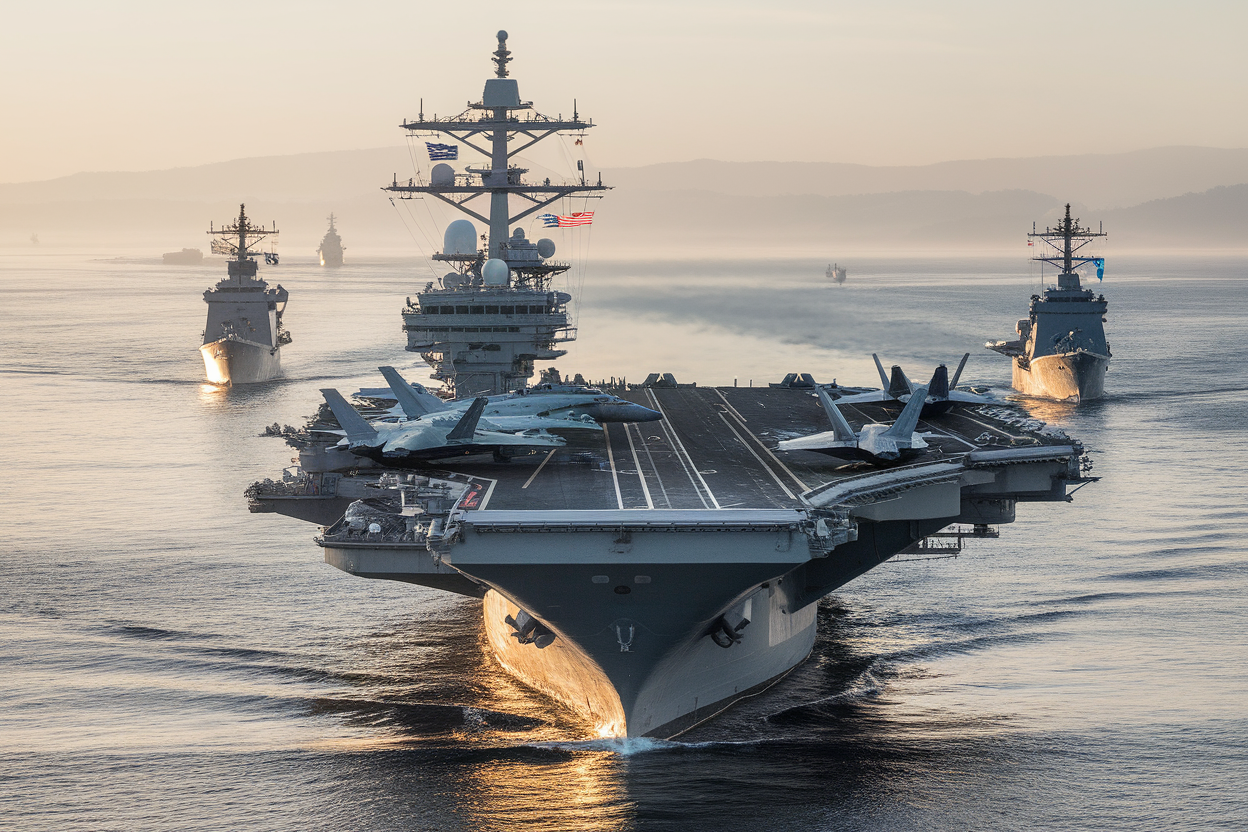
The USS George H.W. Bush just left Norfolk, Virginia, pointed toward the Middle East. If it slots in as planned, the U.S. will have three nuclear-powered aircraft carriers within striking distance of Iran—alongside the USS Gerald R. Ford and the USS Abraham Lincoln, already operating in the region.
That’s a big deal. Not because Washington suddenly discovered the concept of “deterrence,” but because stacking three carriers in one theater is usually what you do when you’re either gearing up for something ugly—or you’re already burning through ships, planes, and people faster than you want to admit.
The official messaging, per Pentagon communications echoed by war.gov, tries hard to keep the temperature down. No chest-thumping about escalation. But defense analysts read the tea leaves differently: this looks less like a dramatic new move and more like reinforcement for a campaign that’s already chewing up readiness.
The Bush brings roughly 80 aircraft—and a “100 sorties a day” talking point
The George H.W. Bush is a Nimitz-class carrier. The deployment materials describe an air wing of about 80 aircraft, including F/A-18 fighters and EA-18G Growlers for electronic warfare.
The Navy loves to cite a capacity of more than 100 sorties per day. Sure—on a good day, with the weather cooperating, the flight deck humming, the jets healthy, and the threat environment manageable. In real life, sortie rates are a cruel math problem: every launch burns fuel, munitions, maintenance hours, and crew sleep. Push the tempo long enough and you start paying in broken gear and bad decisions.
The Growlers matter here. If you’re posturing near Iran, you’re thinking about radars, comms, drones, and layered air defenses. EA-18Gs are the aircraft you bring when you want to make the other guy’s sensors lie to him.
And yes, the timing is political. The Pentagon wants you to believe the Bush isn’t being shoved out the door in a panic—that it’s trained up, escorted, and ready. But carriers don’t “rush” without consequences. Any acceleration tends to show up later as deferred maintenance, parts shortages, and exhausted sailors.
Three carriers in one region is rare—and it’s expensive for a reason
Putting the Ford, Lincoln, and Bush in the same theater doesn’t automatically mean the U.S. is about to launch a full-scale war. It does mean the White House wants redundant options.
Redundancy sounds boring until something breaks. A carrier can lose tempo because of mechanical issues, flight deck damage, or a maintenance problem that can’t be waved away with a press release. With three carriers, if one has to throttle back, the other two can keep flying and keep the pressure on.
And the threat picture near Iran isn’t one-dimensional. You’re talking ballistic and cruise missiles, drones, swarm-style attacks, proxy forces, and plain old maritime risk. One carrier group can deter. It can also become a single, politically juicy target. Multiple groups complicate Iran’s planning and spread the risk.
The other unspoken part: guided munitions and aircraft parts aren’t infinite. Sustained operations grind down inventories. That’s not drama—that’s logistics.
“Operation Epic Fury” is reportedly in week four—and the claims are huge
The context cited by war.gov describes an ongoing campaign—now in its fourth week—called Operation Epic Fury. According to that reporting, Defense Secretary Pete Hegseth said U.S. attacks were intensifying while Iranian responses were slowing.
The same material claims U.S. and Israeli forces have carried out thousands of strikes inside Iran. That’s a headline-grabber, and it deserves skepticism about definitions. Are we counting only kinetic strikes? Drone shoot-downs? Electronic attacks? Different channels often lump very different actions into one big number because “thousands” plays better than “here’s the breakdown.”
Still, the core point is hard to miss: this doesn’t read like a holding pattern. It reads like sustained operations—and sustained operations demand fresh capacity. Carrier air wings can’t sprint forever without safety and readiness slipping. A third carrier is one way to keep the machine running without snapping it in half.
Also, don’t get hypnotized by “Iranian responses slowing.” Sometimes that means an adversary is hurt. Sometimes it means they’re adapting—dispersing, hiding, shifting to indirect attacks, or waiting for a moment when the U.S. gets complacent.
The real tell: the Ford has been out nearly 11 months
The most revealing detail here isn’t the carrier count. It’s time. The USS Gerald R. Ford has reportedly been at sea for nearly 11 months—way beyond the often-cited 6 to 8 months for a typical deployment.
That kind of extension hits everything: morale, maintenance, system availability, and the ability to reset for the next mission. The same source notes a fire aboard the Ford, which—even if contained—tends to trigger inspections, repairs, and operational reshuffling. In a campaign where tempo is part of the message, interruptions become a credibility problem.
So the Bush sailing isn’t just about “showing the flag.” It’s about sustainability. Carriers are floating cities with nuclear reactors and a flight line. Their real power is the ability to launch, recover, arm, refuel, and do it again tomorrow. Stretch a deployment too long and you rack up deferred maintenance that comes due later—with interest.
The Lincoln serves as another pillar. The Bush becomes the third. Together, they can divide up missions—presence, air cover, strike capacity, deterrence, sea-lane protection—and absorb the inevitable surprises. In that part of the world, planning assumes something will go wrong. Hope isn’t a strategy.
And looming behind all of it is an old American argument: do we actually have enough ready carriers to handle multiple crises without breaking the force? Keeping the Ford out for 11 months suggests strain. Sending the Bush helps now—but it also pushes the maintenance bill into the future, because the Bush will eventually have to come home and go into the yard, too.