

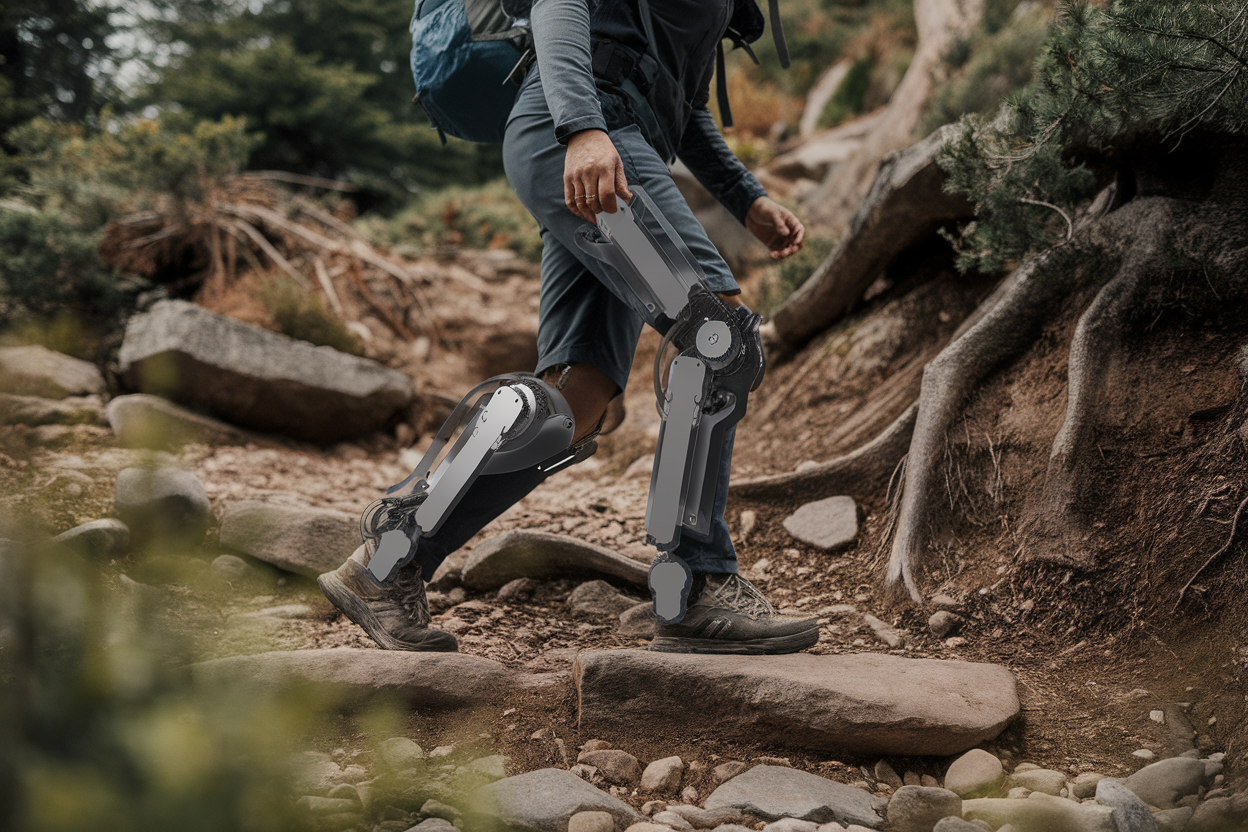
Imagine strapping on a powered brace that gives your stride a little extra pop—especially when the trail turns ugly. That’s the pitch behind Hypershell’s new “X Series” walking and hiking exoskeletons: wearable assist gear that’s supposed to adjust its help depending on terrain, how long you plan to be out, and how much support you want.
The company’s big selling point is “AI-driven motion control.” Translation: instead of pushing with the same force all the time like a dumb motor, it’s trying to time its assistance to your actual gait—speeding up, slowing down, climbing, descending, stepping over rocks—without turning your walk into a tug-of-war.
AI “motion control” isn’t autopilot—it’s a timing problem
Walking-assist exoskeletons don’t live or die on raw power. They live or die on timing.
If the boost hits too early, it throws you off. Too late, it’s useless. Hypershell is betting that software—specifically an AI-flavored control loop—can keep the device synced with the messy reality of human movement.
The easiest analogy is a drone stabilizer: sensors take measurements, the system estimates what’s happening, then it corrects. Except here the “state” isn’t altitude or yaw—it’s whether your foot is loading, pushing off, transitioning from flat ground to a climb, or shortening your steps because the trail just turned into ankle-breaking rubble.
On paper, that’s exactly what you’d want. In real life, the nightmare scenario is an assist system that “helps” in a way your body didn’t ask for. Human gait is rhythmic, sure—but it’s never perfectly repeatable. A good exoskeleton has to roll with that variability like a well-tuned suspension, not bounce you around like a shopping cart with a bad wheel.
Trails are chaos, and that’s where exoskeletons get exposed
Hypershell is aiming this at walking and hiking across varied terrain, and that’s not a casual choice. The moment you leave flat pavement, your body starts making constant micro-corrections—ankle tweaks, knee angle changes, shorter footfalls, occasional side-steps to avoid a root or a loose rock.
A device that feels fine on a sidewalk can fall apart on a real trail. Helping with forward propulsion isn’t the same as helping with stability. Helping uphill isn’t the same as helping downhill. And if the system can’t recognize those transitions quickly, you don’t get “assistance”—you get interference.
Hypershell’s language about different terrain, range, and support levels strongly hints at selectable modes or adjustable assistance levels. That’s smart, because too much boost at the wrong moment doesn’t just feel weird—it can make you less confident in your footing. And on uneven ground, confidence is the whole ballgame.
The X Series sounds like multiple models, not one do-everything rig
Hypershell calls it the “X Series,” plural, which suggests a lineup—different versions tuned for different use cases, with tradeoffs in how much help you get, how long it lasts, and where it’s meant to be used.
Consumer exoskeletons usually force you to pick your poison across three categories:
First: how noticeable the assistance feels. More help can be great—until it’s even slightly out of sync.
Second: endurance. Continuous assist means serious battery and power management if you’re out for a long hike.
Third: ergonomics. Weight, bulk, freedom of movement, and whether you can actually put the thing on and adjust it without a 20-minute wrestling match.
Hypershell keeps talking about adding “spring” to your step. The idea is basically energy in/energy out—like a spring that stores and returns some of the mechanical energy of walking—but with active control deciding when and how that return happens. Think of it as moving from a passive spring to a “smart spring” that changes behavior depending on what you’re doing.
And splitting the lineup by support level is also a way to dodge a classic trap: the exoskeleton that tries to do everything usually ends up being mediocre at all of it. Hypershell’s approach sounds closer to how people actually buy gear—trail shoes for trails, street shoes for streets.
AI, fitness, and marketing: the promise is real, the hype is optional
Hypershell is planting its flag at the intersection of mobility assist, outdoor performance, and fitness gadgetry. “AI” is the shiny hood ornament—meant to signal real-time adaptation and a kind of implicit personalization.
Here’s the reality check: walking assistance can absolutely reduce perceived fatigue in certain situations. But the user experience hinges on integration. An exoskeleton can help during one slice of the stride and annoy you during another. AI doesn’t magically fix that—it’s just a tool for tuning the timing and the feel.
If Hypershell’s control system is good, the assist should feel natural—present, but not bossy. If it’s bad, you’ll spend your hike thinking about the machine instead of the trail. And for walking and hiking, the truth comes out in brutally specific moments: pace changes, slope transitions, uneven ground, and whether the device can keep helping without surprising you.
That’s the bet behind the X Series: make exoskeleton assistance feel less like wearing a robot and more like wearing gear that quietly has your back. Because if it’s uncomfortable—or even just slightly out of rhythm—you won’t tolerate it for long. A poorly fitted backpack gets annoying in minutes. A poorly timed exoskeleton gets annoying faster.