

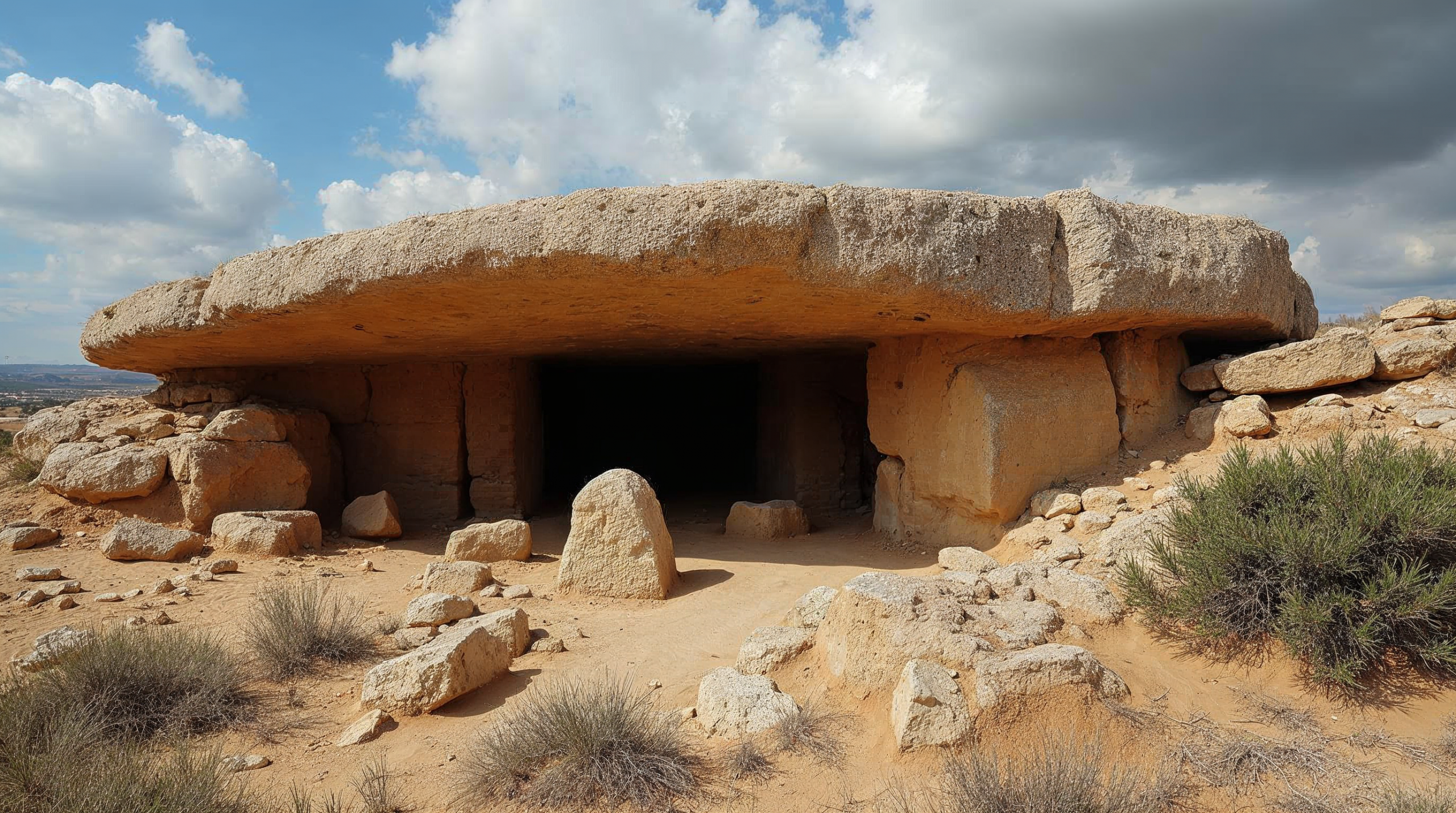
At the entrance of a hulking Stone Age tomb in southern Spain, archaeologists found two medieval men—buried a thousand years ago in a monument that was already ancient when Rome was a rumor.
And one of those men, according to ancient DNA, carried a genetic mix tied to Europe, North Africa, and the eastern Mediterranean. Not exactly the tidy “locals only” story people like to tell about the Middle Ages.
A Stone Age mega-tomb that still pulls people in
The Dolmen of Menga sits outside Antequera in Andalusia, part of a UNESCO-listed complex Americans might think of as Spain’s answer to a megalithic national park—except the main attraction is a tomb.
Menga isn’t subtle. It’s a corridor grave about 82 feet long and roughly 20 feet wide, built from massive upright stones and capstones. Some blocks are estimated around 165 tons. That’s not “a few villagers with free time.” That’s a society with serious organization, muscle, and motive.
The point: this place has dominated the landscape for 5,000-plus years. So it shouldn’t shock anyone that later people kept coming back to it—sometimes for reasons that had nothing to do with the original builders.
The 2005 dig: two medieval burials where they don’t “belong”
In 2005, archaeologists excavating the dolmen’s entrance area uncovered two adult male burials. These weren’t prehistoric leftovers; their placement made it clear they were added long after the monument was built.
Radiocarbon dating pinned the better-preserved individual to roughly the 10th–11th centuries AD. The second man dated more broadly, somewhere between the 8th and 11th centuries.
They were laid in simple pits, with no grave goods reported. But the bodies weren’t tossed in carelessly: both were aligned with the dolmen’s axis. Their heads pointed southwest, faces toward the southeast.
Researchers suggest that orientation could reflect an attempt—imperfect, but intentional—to aim the dead toward Mecca. It doesn’t match a textbook Islamic burial layout, though, and that’s the interesting part. Medieval life around the Mediterranean was messy: mixed communities, mixed customs, and rituals shaped by whatever physical space you had. Try fitting a “canonical” burial into the cramped geometry of a prehistoric stone corridor and see how perfect your angles stay.
Ancient DNA in hot-country conditions: degraded, scarce, and still useful
Getting ancient DNA out of remains from Mediterranean Iberia is often a slog. Heat and soil chemistry are brutal on genetic material, and the ScienceDirect-hosted study describes the DNA here as extremely low-content and heavily degraded.
So the team used a targeted method called SNP enrichment—basically a way to fish out informative genetic markers even when the sample is in rough shape. It worked well enough to generate a usable genome-wide profile for one individual, labeled Menga1. The other man’s remains didn’t cooperate to the same degree.
This is the part where archaeology stops being only about bones and layers of dirt and starts hinting at family histories written across centuries: not a literal travel itinerary, but the accumulated signal of ancestry shaped by migration, marriage, conquest, trade, slavery, and plain old human movement.
Menga1: a genetic mash-up spanning Europe, North Africa, and the Levant
Menga1’s profile came back as a blend: lineages described as typical of European populations, plus genome-wide contributions linked to North Africa and the Levant (the eastern Mediterranean).
That doesn’t mean the guy personally hopped on a boat from Beirut to Málaga. DNA can’t hand you a passport stamp. What it can do is show that, by the medieval period, the human web around the Mediterranean had already been tangled for a long time.
And it makes the burial choice feel less random. A prehistoric dolmen isn’t just a pile of old rocks—it’s a landmark soaked in meaning. People reuse places like this because they’re powerful, because they’re visible, because they’re already associated with death, or because they’ve become local reference points wrapped in story and superstition.
The careful alignment of the bodies with the monument’s axis strengthens the case that this was deliberate. These men weren’t buried “nearby.” They were placed in conversation with the dolmen—its corridor, its geometry, its built-in symbolism of passage.
A UNESCO site with a new problem: time, weather, and vanishing evidence
The Menga story isn’t only about ancestry. It’s also about how places collect layers of use: Stone Age tomb, medieval burial ground, modern heritage site. Each era adds its own meaning without fully erasing what came before.
There’s also a practical warning baked into the research. If DNA preservation is already poor in warm Mediterranean environments, a warming climate and shifting environmental pressures can make the biological archive even harder to recover in the future.
So yes, a 5,000-year-old monument is still producing new information. But it’s also a reminder that some of the most valuable evidence—genetic, organic, fragile—doesn’t wait around forever.