

Oracle is done selling you a chatty helper that drafts emails and fills in forms. Now it wants software that actually does the work.
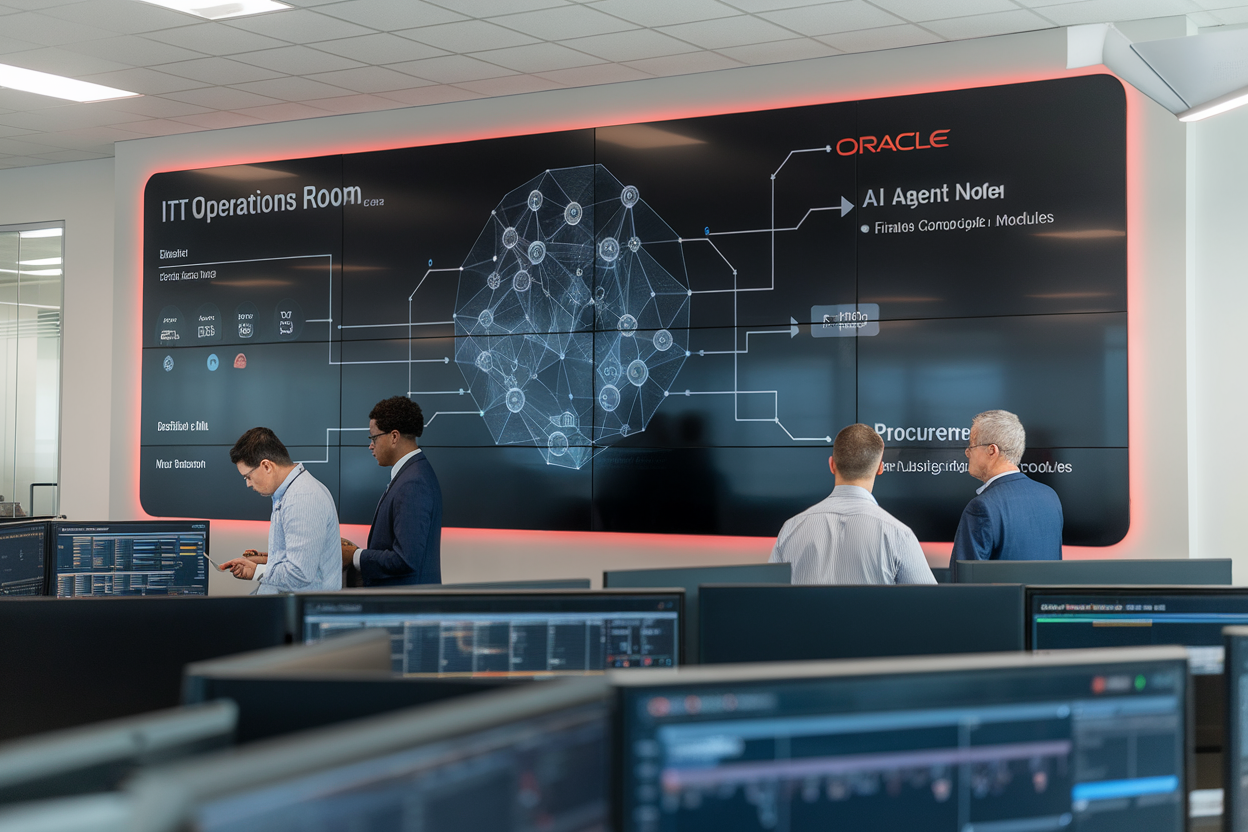
This week, the company said it’s adding a new layer of autonomous AI “agents” to its Fusion Cloud Applications—Oracle’s big suite for finance, procurement, HR, and customer operations. The pitch: stop treating AI like a polite assistant and start treating it like a digital employee that can take a business goal, run the steps, coordinate across modules, and close the loop without a human approving every click.
That’s the dream. The nightmare is obvious: when you let software act inside an ERP—the system that cuts checks, books revenue, and updates employee records—mistakes aren’t cute. They’re expensive. Sometimes illegal.
Oracle’s new line in the sand: “agents” chase outcomes, not answers
For years, “AI in enterprise software” mostly meant a middleman: you ask, it summarizes; you request, it suggests; you complain, it drafts a response. Useful, sure. But it still leaves the human as the doer.
Oracle’s framing is sharper: these agents are supposed to hit measurable business targets autonomously. In Fusion, that could mean shrinking invoice processing time, triggering payment reminders, updating supplier data, or kicking off an HR action when a specific event hits the system.
In other words, the AI isn’t just talking about the work. It’s acting inside the system of record.
And that changes how you judge it. A chatbot gets graded on whether the answer sounds right. An autonomous agent gets graded on whether the job is actually finished: ticket closed, exception resolved, transaction processed.
“Teams” of agents sound great—until you ask who’s accountable
Oracle is also leaning into the idea of multiple specialized agents working together—one gathers info, another verifies, another executes. That’s how real operations work, and it’s how automation breaks in the real world: handoffs, edge cases, and conflicting instructions.
Once you’ve got a little agent swarm running around your finance and HR stack, you need orchestration that’s more than a PowerPoint word. Who does what, in what order, under what stop conditions? What happens when two agents disagree? Who detects an infinite loop before it spams your vendor master with garbage?
Enterprise buyers won’t be impressed by a slick demo. They’ll ask for boring, life-saving controls: action caps, whitelists, consistency checks, and a clean “kick it to a human” path when the situation goes sideways.
Permissions and audit logs: the difference between “automation” and “oh no”
If an agent can create a vendor, change bank details, approve an expense report, or trigger a purchase order, you’re in the danger zone. That’s where fraud lives. That’s where compliance teams start sharpening knives.
So autonomy has to be graduated. Read-only. Then “recommend.” Then “execute with approval.” And only then, for tightly defined cases, “execute without approval.” Skip that ladder and you get one of two outcomes: a risky system nobody trusts—or a “self-driving” agent that asks permission every 30 seconds and ends up being… a chatbot with extra steps.
Then there’s traceability. Auditors don’t care that the AI “reasoned” its way to a decision. They want a log: what data it touched, what rules it applied, what it decided, what it changed, and why. If Oracle wants big regulated customers to let agents loose in ERP workflows, the audit trail has to meet ERP standards—not consumer app standards.
Productivity is the sales pitch—but the bill and the data mess show up fast
Oracle’s argument is that autonomous agents deliver end-to-end gains, not tiny time-savers. Instead of shaving minutes off an employee’s day, the agents are supposed to compress entire cycles: fewer delays, more throughput without hiring, more standardized execution across high-volume processes like invoices, reconciliations, reminders, internal requests, and repetitive data entry.
There’s also a budget angle. CIOs are sick of stacking niche tools that need endless integration work. Oracle can sell “built-in” agents as cheaper and cleaner because they sit right next to the data and the business rules.
But don’t confuse “integrated” with “free.” Costs can slide into cloud consumption, add-on licensing, and change management. Oracle didn’t spell out pricing or the exact agent lineup in the information provided—an omission that matters, because ROI math gets squishy fast when you’re already locked into multi-year enterprise contracts.
And here’s the unsexy truth: autonomous agents don’t need to be dumb to fail. Bad vendor records, conflicting master data, undocumented local rules—any of that will wreck automation. If Oracle’s customers want real autonomy, they’re signing up for the classic data-governance cleanup they’ve been dodging for years.
Oracle isn’t alone—Microsoft, SAP, and Salesforce are chasing the same prize
This is an arms race. Microsoft is pushing Dynamics 365 with Copilot. SAP has Joule and a growing automation story. Salesforce is going hard on agent-driven CRM. Everyone wants “agentification”: AI that can call APIs, move through apps, and execute sequences—not just chat.
Oracle’s edge, if it has one, is the old-school strength it rarely brags about because it’s not sexy: tight integration and deep control over business processes. That’s exactly what you need if you’re going to let software act autonomously in finance and HR without blowing a hole in your controls.
The flip side: an agent is also a new attack surface. If credentials get compromised, if configuration is sloppy, if someone slips malicious instructions into a data stream, the AI doesn’t just leak information—it can do things. Real things. Expensive things.
Regulators and internal trust will decide how far this goes
In Europe, the EU AI Act pushes companies to evaluate AI by use case and risk level. Agents that touch HR or financial decisions can trigger heavier obligations—more oversight, more explainability, more human supervision. Even if Oracle sells the tooling, the company using it owns the consequences.
And inside any big organization, trust is the real bottleneck. Plenty of executives still have PTSD from rigid automation and soul-crushing ERP rollouts. Adding an “intelligent” layer that can act inside the system will make some teams move faster—and others slam the brakes.
Oracle’s agents won’t be judged by how clever they sound. They’ll be judged by whether they can run thousands of daily transactions, stay inside the guardrails, and be reversed cleanly when they screw up.
FAQ
What’s Oracle’s difference between a digital assistant and an autonomous AI agent?
Oracle’s line is that assistants help users—answering questions or suggesting actions—while autonomous agents pursue a business goal and can execute multi-step operations inside Fusion Cloud with higher delegation, governed by rules and access controls.
What are the biggest risks of autonomous agents inside an ERP?
Permissions (sensitive actions), traceability (audit and justification), security (bigger attack surface), and compliance—especially when agents touch HR or financial workflows.
Why is Oracle pushing this now?
Because Microsoft, SAP, and Salesforce are all racing toward execution-focused AI. Oracle wants autonomy embedded directly in its business apps to drive end-to-end productivity gains.